Florida Green Construction Standards: A Developer’s Guide to 2026 Certifications
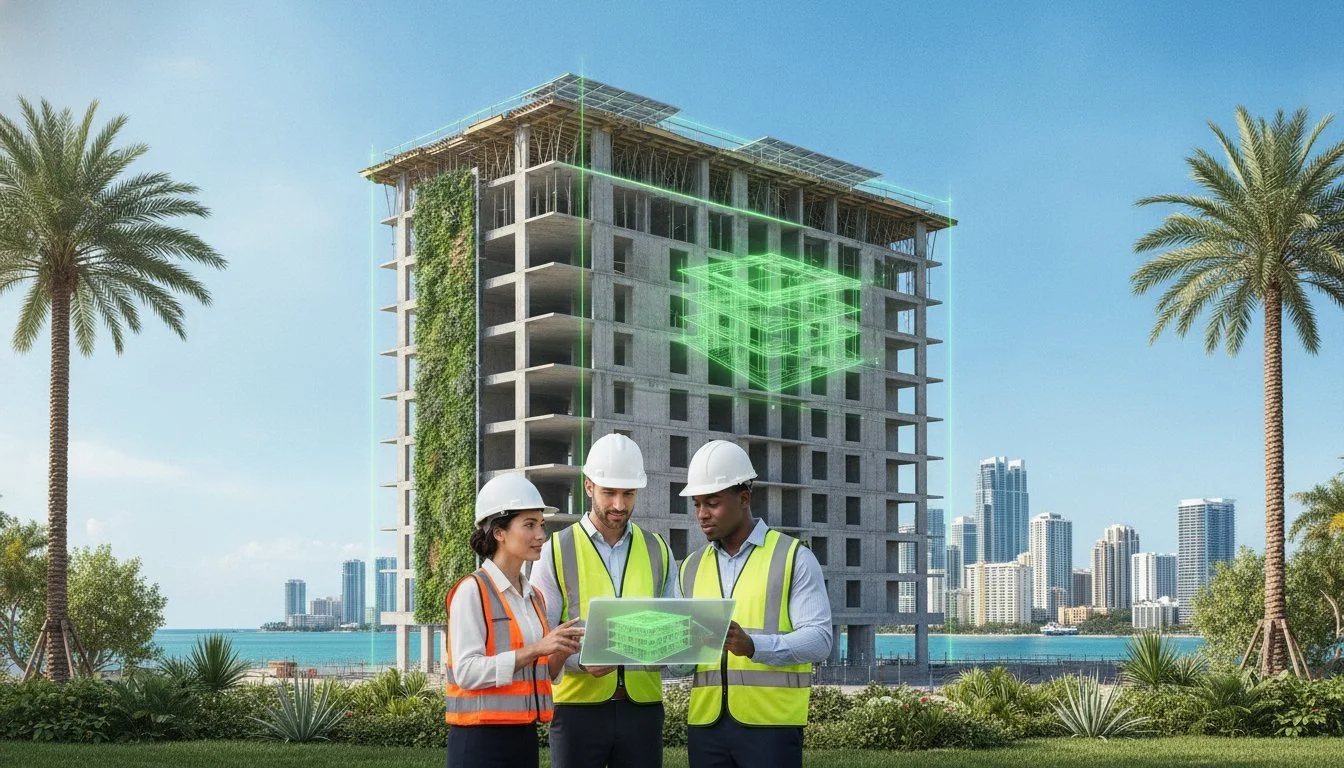
Building to code in the Sunshine State is no longer just about passing a basic inspection; it's about ensuring your investment is truly survivable. As the 9th Edition of the Florida Building Code takes effect in late 2026, the gap between standard practice and high-performance excellence is widening. You likely feel the pressure of aligning complex Florida green construction standards with local mandates while managing the technical overhead of third-party verifications. It's a significant challenge to build structures that can withstand 160 mph winds and Florida's unique humidity without compromising on your project's timeline or budget.
We understand that these shifting requirements can feel overwhelming, but they also represent a powerful opportunity to lead the market. This guide provides a clear roadmap to master the 2026 landscape of FGBC, LEED v5, and NGBS certifications. You will learn how to leverage these frameworks to achieve higher property valuations and superior building durability. We will examine the latest updates to each standard and provide a practical strategy for delivering resilient, high-performance properties that thrive in our specific climate.
Key Takeaways
Understand why 2026 marks a pivotal shift in the Florida regulatory landscape and how the new building code influences your project's baseline performance.
Discover how to navigate the latest Florida green construction standards to select the ideal certification—LEED, FGBC, or NGBS—based on your specific market positioning.
Learn how high-performance building envelopes and advanced water stewardship strategies mitigate risks associated with Florida’s intense humidity and hurricane threats.
Master the roadmap for seamless certification by integrating specialized consultants early in the pre-design phase to prevent costly late-stage technical corrections.
Explore how professional verification services, such as LEED Green Rater or NGBS Green Verification, translate into higher property valuations and long-term building durability.
Table of Contents
The Evolution of Florida Green Construction Standards in 2026
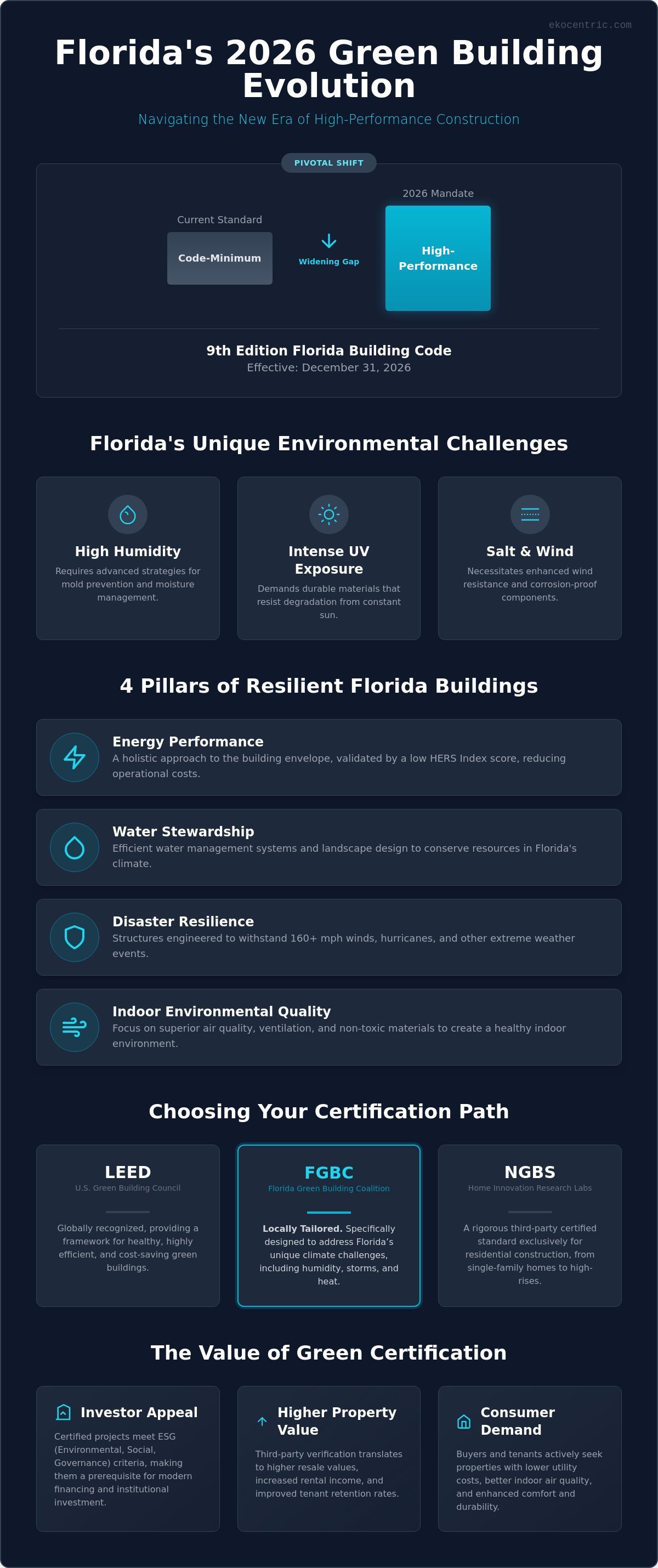
Florida green construction standards represent a dedicated commitment to building properties that endure. In our state, these aren't just aspirational goals. They are technical frameworks designed to ensure structures survive our unique environmental stressors. The year 2026 marks a decisive turning point. With the 9th Edition of the Florida Building Code set to take effect on December 31, 2026, the industry is shifting from voluntary "eco-friendly" features to integrated performance mandates. We're moving toward a future where high-performance building is the only way to remain competitive.
Three primary organizations lead this movement by providing rigorous verification paths. The U.S. Green Building Council oversees Leadership in Energy and Environmental Design (LEED), while the Florida Green Building Coalition (FGBC) provides locally tailored criteria. Home Innovation Research Labs manages the National Green Building Standard (NGBS). These bodies offer the technical services required to prove a project meets high benchmarks for energy, water, and structural durability.
To see how these standards translate into physical resilience, watch this demonstration of hurricane-resistant wall systems:
Why Florida-Specific Standards Matter
Florida's Climate Zones 1 and 2 present atmospheric challenges that national standards often overlook. High humidity, intense UV exposure, and salt-spray environments accelerate material degradation. The FGBC standards focus specifically on these local stressors. While the Florida Building Code sets the floor for safety, Florida green construction standards raise the ceiling for performance. They address critical regional needs like advanced mold prevention and enhanced wind resistance that are vital for our state's long-term survival.
Market Drivers for Green Certification
Institutional investors now prioritize ESG-compliant assets. This makes third-party certification a prerequisite for many modern financing rounds. Consumers also drive this change. They want lower utility costs and better indoor air quality. A certified home or commercial space isn't just better for the environment; it's a more valuable asset. Verified sustainability leads to higher resale values and improved tenant retention. In a competitive market, these credentials distinguish high-quality builds from standard, code-minimum construction. Our team sees this shift as a positive step toward a more resilient and responsible built environment.
Core Pillars of Sustainable Building in the Sunshine State
Building in Florida requires a specialized approach because our environment is relentless. To meet the evolving Florida green construction standards, developers must focus on four foundational pillars: energy efficiency, water stewardship, disaster resilience, and indoor environmental quality. These aren't isolated goals. They work together to create a structure that's both efficient and enduring. For instance, a high-performance building envelope reduces energy demand while simultaneously providing the airtight seal necessary to manage our state's extreme humidity.
We've moved past the era where a few solar panels defined a green project. True sustainability now lives within the walls and systems of the building itself. This holistic view ensures that every resource is used effectively, from the electricity powering the HVAC to the water nourishing the landscape. By prioritizing these pillars, you create a property that's prepared for the environmental and regulatory realities of 2026.
Energy Performance and the HERS Index
The HERS Index serves as the 'miles per gallon' rating for Florida homes, providing a clear benchmark for energy performance. Achieving a low HERS score requires more than just efficient appliances. It demands a holistic focus on airtightness and insulation that can withstand a sub-tropical climate. By optimizing the envelope with higher R-values, as mandated by the upcoming 9th Edition of the Florida Building Code, you ensure the HVAC system doesn't have to work overtime to combat the heat. This level of precision is what separates a standard build from a high-performance asset.
Climate Resilience: Building for the Next Storm
In hurricane-prone regions, a building isn't truly green if it isn't also strong. The 2026 updates, including House Bill 911, expand requirements for impact-resistant building envelopes to withstand wind events of at least 160 mph. This focus on resilience is a core component of the Florida Green Building Coalition (FGBC) standards. By using materials with low embodied carbon that also offer high impact resistance, you create a synergy between sustainability and safety. This approach often leads to improved building durability and can help projects qualify for various insurance mitigation credits. If you're looking to integrate these complex requirements, exploring professional verification services can help ensure your project meets every benchmark.
Water stewardship and Indoor Environmental Quality (IEQ) round out these pillars. Florida’s aquifers are precious, and managing runoff through xeriscaping and low-flow tech is critical for ecological health. Simultaneously, we must address IEQ by aggressively combating humidity to prevent mold and allergens. A truly green building provides a healthy sanctuary for its occupants, ensuring long-term comfort and safety while protecting the developer's investment from moisture-related degradation.
Comparing FGBC, LEED, and NGBS for Your Project
Selecting the right path among Florida green construction standards is a strategic decision that impacts both your construction budget and your property's eventual marketability. It's not a one-size-fits-all choice. Developers must weigh the global recognition of international brands against the localized climatic specialization of regional programs. Each framework offers distinct advantages depending on whether you're building a luxury high-rise, a multi-family complex, or a single-family community.
The administrative premium and construction rigor vary significantly between these systems. While some standards prioritize broad environmental categories, others focus intensely on the specific structural and moisture-management needs of the Florida peninsula. Your choice should align with your investor expectations and your long-term goals for building durability.
LEED BD+C and LEED for Homes in Florida
LEED remains the international gold standard for prestige. It's the ideal choice if your project targets institutional investors or global tenants who demand recognized ESG credentials. However, the rigor of LEED v5, which launched in 2025, requires meticulous management of Florida's latent cooling loads. To succeed in this track, residential projects must engage a LEED Green Rater early in the process. This specialist ensures that high-performance design translates into verified field results, helping you manage the complexities of decarbonization and ecological restoration that the new v5 standard emphasizes.
The FGBC Advantage for Local Developers
The Florida Green Building Coalition (FGBC) offers the most 'Florida-friendly' certification path because it was built specifically for our state's unique topographies and hurricane risks. The FGBC points system is flexible. It allows developers to earn credits for strategies that make sense in a sub-tropical environment, such as advanced mold prevention and salt-spray resistant materials. Because it aligns closely with the 9th Edition of the Florida Building Code, it often reduces compliance friction during the permitting process. It's a pragmatic choice for regional developers who want a high-performance label backed by local expertise.
For multi-family developers looking for a streamlined verification process, the ICC 700-2025 National Green Building Standard (NGBS) is a powerful tool. Released in April 2026, this fifth edition is designed for scale and efficiency. It provides a clear, rigorous path for high-volume residential projects without the administrative overhead often associated with international programs. As of early 2026, the NGBS has certified its 750,000th project, proving its status as a trusted industry workhorse. Whether you choose the prestige of LEED, the local relevance of FGBC, or the multi-family efficiency of NGBS, your commitment to these standards ensures a more resilient future for Florida's built environment.
The Roadmap to Achieving Green Certification
Success in meeting Florida green construction standards starts months before the first shovel hits the dirt. Many developers make the mistake of treating certification as a final checklist. In reality, it's a structural commitment that begins during the pre-design phase. This is when you define your performance goals and select the framework that best serves your project's market position. Setting these targets early prevents the expensive "re-engineering" that occurs when green features are added as afterthoughts.
The design charrette is your most valuable tool during this initial stage. By bringing architects, engineers, and sustainability consultants together in one room, you can align every system for maximum efficiency. This collaborative session ensures that the building envelope, HVAC sizing, and water systems work in harmony. It's much easier to optimize a blueprint than it is to fix a failing performance test on a nearly completed structure.
Selecting Your Green Building Team
You need a partner who understands the technical nuances of Florida's regulatory environment. Integrating a LEED Green Rater or NGBS Verifier into your workflow from day one ensures that your design is actually buildable and verifiable. These experts act as the bridge between visionary design and technical compliance. They track the specific requirements of LEED v5 or the ICC 700-2025 standard so your team can focus on construction. To get started on the right path, explore our green building consulting services to see how we can streamline your project's verification.
Field Verification and Performance Testing
Once construction begins, the focus shifts to rigorous on-site inspections. Florida's climate demands specific performance tests that aren't optional for high-performance builds. These include:
Blower door testing: Measuring the airtightness of the building envelope to prevent energy loss and humidity intrusion.
Duct leakage testing: Ensuring the HVAC system delivers air precisely where it's needed without wasting energy in unconditioned spaces.
Material tracking: Documenting the use of low-VOC materials and sustainable sourcing to meet specific credit requirements.
Common pitfalls in Florida projects often lead to certification delays. These typically involve poor moisture management during the framing stage or failing to track waste diversion rates correctly. A proactive approach to documentation keeps the project on schedule. Final verification is the moment of truth. A third-party rater conducts the ultimate performance tests to confirm the building meets the chosen standard. This independent verification is what provides the higher property valuations and investor confidence that modern developers require. If you're ready to secure your property's future, partner with an experienced green building consultant to manage your certification roadmap.
Partnering with Ekocentric for Seamless Certification
Achieving Florida green construction standards requires more than just a commitment to sustainability; it demands a partner who can translate complex technical requirements into actionable field results. We act as the essential bridge between your design team's vision and the rigorous benchmarks of third-party verification. Developers often face a gap in internal capacity when managing the specialized documentation and on-site testing required for 2026 certifications. Our role is to fill that gap with professional authority and a pragmatic approach that keeps your project on schedule.
We believe that high-performance building is a crucial and achievable solution to our state's environmental challenges. By providing expert guidance from the earliest stages of a project, we help you avoid the common pitfalls that lead to certification delays or performance failures. Our mission-driven passion for environmental stewardship is matched by a deep understanding of your business realities, ensuring that every sustainability goal also serves to enhance your property's long-term value and durability.
Comprehensive LEED and FGBC Consulting
Our team specializes in streamlining the LEED BD+C process, providing the technical oversight necessary to secure international prestige for your development. We offer a rare combination of LEED BD+C consulting and LEED Green Rater services, ensuring a seamless flow from design documents to final field verification. This dual expertise is particularly valuable in Florida's high-humidity market, where moisture management and energy performance are non-negotiable. We also provide expert guidance for the Florida green construction standards set by the FGBC, helping regional developers navigate the localized requirements that national programs might overlook. This rigorous third-party verification protects your investment and confirms your asset's performance to institutional investors and future tenants.
Ready to Certify Your Next Florida Project?
Early-stage involvement is the most cost-effective way to ensure your project's success. When our consultants are integrated into your workflow during the pre-design phase, we can optimize the building envelope and HVAC systems to meet Energy Star and RESNET HERS requirements without expensive late-stage changes. We provide the technical expertise to manage National Green Building Standard Green Verification and FGBC Certification Consulting, tailoring our solutions to the unique needs of the Florida market. Whether you're aiming for the global recognition of LEED or the regional relevance of FGBC, we provide the reliable, insightful partnership you need to succeed. Contact Ekocentric today to start your certification journey and build a more resilient future for Florida.
Leading the Future of Florida Development
The 2026 regulatory shift isn't a hurdle to clear; it's a foundation to build upon. By adopting Florida green construction standards, you're choosing to create properties that are as durable as they are efficient. We've explored how the right certification path, whether LEED, FGBC, or NGBS, provides a roadmap to higher asset value and climate resilience. Integrated design and third-party verification ensure your project meets the highest benchmarks for moisture management and structural integrity.
Success in this evolving market requires a partner who understands the technical nuances of our sub-tropical climate. We bring specialized LEED Green Rater expertise and deep knowledge of Florida-specific FGBC standards to every project. Our proven track record with LEED BD+C and NGBS developments ensures your vision translates into a high-performance reality. It's time to turn these standards into your competitive advantage.
Schedule your green building certification consultation with Ekocentric. Together, we can build a more resilient and sustainable Florida for generations to come.
Frequently Asked Questions
Is green building certification mandatory for new construction in Florida?
Green building certification is voluntary for most private developments but mandatory for state-funded buildings with construction costs exceeding $2 million. Under Florida's High-Performance Green Building Act, these specific projects must achieve LEED Silver or a comparable FGBC rating. While not required by state law for all projects, many local jurisdictions offer incentives like expedited permitting for those following Florida green construction standards. This makes certification a powerful tool for market differentiation and regulatory alignment.
What is the difference between LEED and FGBC certification?
LEED is an internationally recognized brand focused on global sustainability, while FGBC is a locally tailored standard built specifically for Florida's environment. LEED v5 prioritizes decarbonization and ecological restoration on a broad scale. In contrast, FGBC focuses on regional challenges such as high humidity, salt-spray degradation, and extreme hurricane risks. Both systems improve building performance, but FGBC provides more flexibility for the unique topographies and climatic stressors found in the Sunshine State.
How much does it cost to get a building green certified in Florida?
The total investment for certification includes registration fees, third-party verification services, and potential construction premiums for high-performance materials. These costs vary significantly based on the project's scale and the specific certification level targeted. Developers typically find that these initial expenses are offset by improved building durability and higher property valuations. We recommend engaging a consultant during the pre-design phase to identify the most cost-effective strategies for your specific project goals.
What are the requirements for the Florida Green Building Coalition (FGBC) standard?
FGBC utilizes a points-based system that evaluates energy efficiency, water conservation, site preservation, and disaster mitigation. Project teams must follow the prevailing version of the standard in effect at the time of their documentation submittal. Requirements often include the use of drought-tolerant xeriscaping, advanced moisture control, and high-performance building envelopes. Because it's designed by local experts, the standard emphasizes resilience against Florida's specific hurricane and humidity risks more heavily than national programs.
Can an existing Florida home be green certified?
Existing homes can achieve certification through specialized remodeling tracks provided by the NGBS or FGBC. For instance, the ICC 700-2025 National Green Building Standard offers a dedicated path for residential renovations. A 2026 remodel project in Winter Park demonstrated that adhering to these standards can reduce annual energy costs by approximately $1,000. These programs focus on upgrading the building envelope and mechanical systems to improve efficiency, indoor air quality, and long-term structural health.
What is a LEED Green Rater and why do I need one for my project?
A LEED Green Rater is a specialized professional who provides mandatory field verification and performance testing for residential projects. You need one to conduct essential on-site inspections, such as blower door and duct leakage testing, to ensure the building meets LEED's rigorous technical requirements. They act as an independent third party, confirming that the sustainable design features are correctly installed. Their expertise is vital for navigating the certification process and securing the final LEED credential.
How do Florida green standards impact hurricane resilience?
These standards integrate sustainability with structural strength to ensure buildings can survive extreme wind events. By following Florida green construction standards, developers often implement impact-resistant envelopes and reinforced roof systems that exceed baseline code requirements. The 2026 updates to the Florida Building Code already mandate resistance against wind events of at least 160 mph for many structures. Green certifications build upon these mandates, prioritizing materials and methods that offer both low environmental impact and superior disaster resilience.
Which certification is best for multi-family developments in Florida?
The National Green Building Standard (NGBS) is often the preferred choice for multi-family developers due to its streamlined and cost-effective verification process. The ICC 700-2025 version is specifically optimized for the scale and complexity of large-scale residential projects. As of March 2026, the NGBS has reached the milestone of certifying its 750,000th project, proving its reliability in the market. It provides a rigorous framework that allows developers to certify high-volume projects while maintaining a focus on energy efficiency and resident health.