HERS Rating Cost in Florida: 2026 Builder’s Budgeting Guide

If you're still viewing energy compliance as a line-item expense rather than a strategic asset, you might be overspending on every square foot of your 2026 builds. Builders across the Sunshine State are currently facing a perfect storm of rising material prices and the impending 9th Edition of the Florida Building Code. It's completely natural to feel frustrated by the uncertainty surrounding the HERS rating cost in Florida as you finalize your upcoming budgets. You want to deliver high-quality, resilient homes that meet the required ERI score of 58 without compromising your project margins.
We believe that specialized energy practices are a powerful solution to environmental challenges and a pragmatic way to streamline your construction process. This guide will help you move beyond the confusion of third-party fees by revealing the specific factors that drive your rating expenses. You'll discover how to leverage professional energy modeling to actually reduce your total construction costs while ensuring seamless code compliance. We'll also provide a clear roadmap for identifying a RESNET HERS Rater who acts as a dedicated partner in your long-term success.
Key Takeaways
Identify how project scale and architectural complexity directly influence your total HERS rating cost in Florida to ensure accurate budget forecasting.
Use energy modeling as a strategic value engineering tool to optimize your building envelope and lower construction expenses without sacrificing performance.
Streamline your path to compliance by leveraging the Energy Rating Index (ERI) to meet the rigorous demands of Florida’s updated energy codes.
Select a certified RESNET HERS Rater with specific experience in Florida’s climate zones to guarantee technical accuracy and professional reliability.
Table of Contents
Understanding HERS Rating Cost in Florida’s 2026 Market
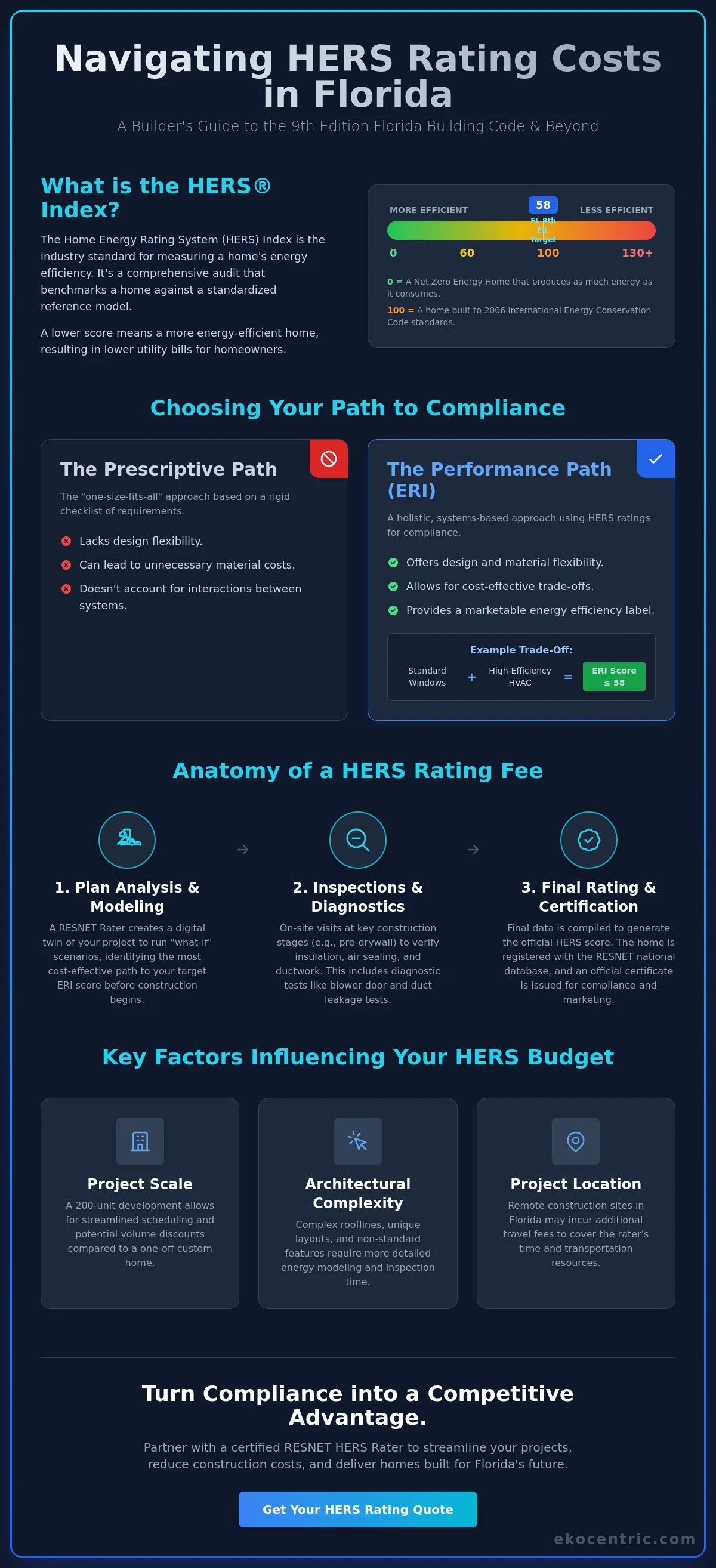
In the high-stakes Florida construction market, the Home Energy Rating System (HERS) serves as the definitive barometer for a building's efficiency. It's more than just a score; it's a comprehensive technical audit that benchmarks a property against a standardized reference home. A score of 100 represents a home built to the 2006 International Energy Conservation Code standards. Today's Florida new builds typically aim for much lower scores to demonstrate superior performance. Understanding your HERS rating cost in Florida is the first step toward building homes that aren't just code-compliant but truly resilient.
To better understand this concept, watch this helpful video:
The HERS Index vs. Florida Building Code
Florida's building codes have evolved to prioritize long-term durability and energy conservation. While the 8th Edition established a strong foundation, the shift toward the Energy Rating Index (ERI) compliance pathway has made HERS ratings an essential tool for project leads. Unlike prescriptive requirements that dictate specific insulation R-values or window U-factors, the HERS performance path looks at the home as an integrated system. This is particularly vital in Florida's unique climate zones 1 and 2. Our hot-humid environment demands specialized attention to moisture control and cooling efficiency that northern standards often overlook. By using the HERS Index, you can prove your project meets the required ERI score of 58 through scientific modeling rather than rigid checklists.
Why Builders are Moving Away from Prescriptive Paths
Rigid prescriptive paths often lead to "one-size-fits-all" solutions that can inflate your budget unnecessarily. Many builders find that these strict requirements don't account for the specific architectural nuances of coastal or panhandle designs. By choosing a HERS-based approach, you gain the flexibility to make strategic trade-offs. For instance, you might invest in a high-efficiency HVAC system to offset standard window specifications while still achieving a score of 58 or lower. This flexibility allows for smarter resource allocation. It also provides a clear, marketable label that resonates with buyers who are increasingly concerned about rising utility costs. Partnering with a RESNET HERS Rater ensures that these technical decisions are backed by precise energy modeling, turning a regulatory hurdle into a competitive advantage.
Breakdown of HERS Rating Professional Fees
Professional fees are the engine behind a verified energy score. They aren't just administrative overhead. They represent a dedicated commitment to verifying that every building component functions as a cohesive, energy-efficient system. Calculating the HERS rating cost in Florida requires a clear understanding of the specialized labor involved, from the initial blueprint review to the final diagnostic testing on-site. These fees cover the rater’s technical expertise and the rigorous quality assurance protocols required by the national registry.
The scale of your project significantly influences the final budget. A single-family custom home in the Keys involves different logistical challenges than a 200-unit multi-family development in Orlando. For production builders, volume often allows for streamlined scheduling, which can mitigate the per-unit expense. Conversely, remote Florida construction sites may incur travel fees to account for the rater's time and resources. Each project also includes administrative costs for RESNET registration and the official issuance of the HERS certificate, which solidifies the home's standing in the national database.
Plan Analysis and Energy Modeling
This pre-construction phase is where your strategy takes shape. We use industry-standard modeling software like Ekotrope or REM/Rate to create a digital twin of your Florida project. This allows us to run "what-if" scenarios, testing different insulation levels or HVAC configurations before a single nail is driven. This proactive approach identifies the most cost-effective path to your target score. Partnering with a RESNET HERS Rater early in the design phase turns these fees into a pragmatic investment in project quality.
Field Inspections and Diagnostic Testing
Fieldwork is the moment of truth for any energy-efficient design. A certified HERS Rater performs critical diagnostic tests, including Blower Door and Duct Leakage testing, to ensure the building envelope is airtight. We also conduct visual inspections of insulation to verify it meets Grade I installation standards. Multiple site visits are standard because they allow us to catch potential issues during the framing and insulation stages. This ensures the final certificate accurately reflects the home's actual performance in Florida’s demanding climate.
Variables That Influence Your Florida HERS Budget
Every construction project represents a unique commitment to quality and efficiency. Because no two buildings are identical, the HERS rating cost in Florida is inherently variable. While a standard bungalow might follow a predictable path, a custom estate with complex rooflines and expansive glazing requires a more intensive technical analysis. These architectural nuances demand additional hours of precision modeling to ensure the digital twin accurately reflects the home's real-world performance. A rater's workload increases alongside the complexity of the building envelope.
Volume discounting provides a significant advantage for production builders. When a developer builds multiple identical units within a single Florida subdivision, the rater can streamline the data entry and inspection process. This efficiency often translates into a reduced per-unit investment for the builder. Large-scale projects may also qualify for specialized sampling protocols overseen by the Residential Energy Services Network (RESNET). These rules allow raters to test a representative percentage of units, which maintains high standards while respecting the builder's timeline and budget.
The technical difficulty of diagnostic testing also plays a role in your final budget. Multi-story homes or properties with multiple HVAC systems require more complex blower door and duct leakage setups. We believe that choosing an experienced RESNET HERS Rater is a pragmatic choice for any project lead. An expert consultant does more than just record data. They provide proactive design feedback that helps you avoid costly errors before they are literally set in stone.
Single-Family vs. Multi-Family Rating Scenarios
Multi-family developments involve distinct sampling protocols that differ from individual residential ratings. These projects often benefit from economies of scale, especially when repeating floor plans across several buildings. RESNET allows for specific sampling rules where a rater tests a subset of units to verify the entire project's compliance. This approach is highly effective for large-scale Florida developments, as it ensures systemic quality without the need for 100% testing on every identical unit.
The Cost of "Failing" an Inspection
Hidden expenses often arise when a home fails its initial diagnostic tests. If a property fails a blower door test due to poor sealing, the rater must return for a re-test after repairs are made. This second visit adds to the total HERS rating cost in Florida and can delay your certificate of occupancy. We recommend maintaining open communication during the framing and insulation stages. Simple pre-drywall walk-throughs often catch sealing issues early, ensuring a first-time pass and keeping your professional fees within the original budget.
Maximizing ROI: How HERS Ratings Pay for Themselves
Viewing energy compliance as a sunk cost is a missed opportunity for your bottom line. While the initial HERS rating cost in Florida covers the rater's technical expertise, the true value lies in the data-driven insights that allow you to optimize your construction budget. By moving beyond the prescriptive path, you can use energy modeling to identify exactly where your dollars work hardest. This pragmatic approach shifts the focus from meeting a minimum standard to creating high-performance assets that command higher market value. We believe that every dollar spent on verification should return even greater value through smarter building practices.
The synergy between HERS and higher-tier certifications like LEED or the National Green Building Standard (NGBS) provides an even broader path to ROI. A HERS rating is the foundational requirement for these prestigious labels. By starting with a HERS-based performance path, you're already halfway toward achieving a "Green" certification that appeals to institutional investors and luxury buyers alike. This layered approach to efficiency ensures that your projects remain relevant and desirable. Even as various temporary financial programs phase out, the inherent market value of verified energy performance continues to rise.
Value Engineering the Building Envelope
Precision modeling reveals opportunities for strategic trade-offs that simple checklists miss. For example, installing a high-efficiency 15 SEER2 air conditioning unit might allow you to use less expensive attic insulation while still meeting Florida’s strict Energy Rating Index requirements. We also analyze the Solar Heat Gain Coefficient (SHGC) of your windows to find the ideal balance for the intense Florida sun. These Ekocentric services help builders identify specific material savings that often exceed the cost of the rating itself. This process ensures every component of the building envelope is sized perfectly for its specific environment, preventing the "over-building" that often plagues prescriptive projects.
Market Differentiation for Florida Developers
Today's buyers are more sophisticated and environmentally conscious than ever before. A HERS certificate provides transparent, third-party proof of quality that sets your project apart in a crowded real estate market. This verification serves as a powerful marketing tool, demonstrating a commitment to resource efficiency and lower long-term operating costs. Beyond sales, verifying performance through a HERS rating reduces long-term liability by ensuring systems like HVAC and insulation were installed to professional standards. This level of oversight protects your reputation and your investment. If you're ready to optimize your next project for maximum performance and profit, explore our RESNET HERS Rater services today.
Choosing a Florida HERS Rater: What to Look For
Selecting a partner to verify your project's energy performance is a decision that impacts your construction schedule and your long-term reputation. While it's natural to compare quotes for the HERS rating cost in Florida, the most valuable partner is one who acts as a pragmatic consultant rather than a simple pass/fail inspector. You need an expert who is deeply committed to environmental stewardship and understands the specific thermal challenges of Florida climate zones 1 and 2. Always verify that your rater maintains active status in the RESNET National Registry to ensure they meet the highest technical standards.
We believe that specialized industry practices are a crucial solution to global environmental challenges. Therefore, we recommend prioritizing firms that offer a broad suite of bundled services. A rater who can handle HERS, National Green Building Standard (NGBS) green verification, and LEED Green Rater services provides a more cohesive experience. This integrated approach ensures that your project's sustainability goals are aligned from the first energy model to the final certificate. It eliminates the friction of managing multiple third-party consultants and keeps your project moving forward efficiently.
The Value of Integrated Consulting
Hiring a rater with deep knowledge in LEED BD+C adds significant value beyond basic code compliance. A "test-only" rater might identify a failure, but a consultant identifies the solution before it becomes a costly delay. Having a single point of contact for all green certifications streamlines communication and ensures consistency across all documentation. Ekocentric’s expertise allows builders to navigate Florida’s unique regulatory landscape with confidence. We provide the technical depth needed to transform complex energy requirements into achievable, high-quality living spaces.
Questions to Ask Your Potential Rater
To ensure you're choosing a reliable partner, use these targeted questions during your vetting process:
"Do you provide design-phase feedback to help us meet our HERS target?" A proactive rater should offer "what-if" modeling to optimize your budget early.
"What is your turnaround time for final certificates after field testing?" Delays in paperwork can stall your certificate of occupancy and impact your bottom line.
"How do you handle re-inspections if a unit doesn’t meet the target score?" Understand their process for troubleshooting and re-testing to avoid unexpected project bottlenecks.
A truly dedicated partner invested in your success will offer clear, direct answers and demonstrate a thorough understanding of the HERS rating cost in Florida as it relates to your specific building type. By choosing a rater who combines technical authority with a passion for resource efficiency, you ensure your 2026 projects are both profitable and environmentally responsible.
Building a Resilient Future for Florida Construction
Managing your 2026 project budget requires a shift from viewing compliance as a hurdle to seeing it as a strategic opportunity. You've seen how your HERS rating cost in Florida is an investment that pays for itself through smart material trade-offs and enhanced market differentiation. By leveraging the performance path of the Florida Building Code, you can deliver high-performance homes that meet the required ERI score of 58 without inflating your overhead. It's a pragmatic way to align your business goals with the growing demand for environmental stewardship.
We're dedicated to helping you navigate this complex landscape with technical expertise and a passion for resource efficiency. Our team of RESNET Certified HERS Raters brings deep knowledge of the Florida Building Code performance path. We offer a unique synergy with LEED and NGBS verification to ensure your projects are both environmentally responsible and financially sound. This integrated approach simplifies your workflow and solidifies your role as a leader in sustainable development.
Optimize your project costs with Ekocentric’s Florida HERS Rater services.
The future of Florida construction is green, resilient, and profitable. We look forward to partnering with you to turn these industry standards into your greatest competitive advantage. Let's build something better together.
Frequently Asked Questions
What is the average HERS rating cost for a new home in Florida?
The average investment for a professional rating typically falls between $500 and $800, though this varies based on building size and architectural complexity. Your HERS rating cost in Florida covers both the technical energy modeling and the mandatory on-site diagnostic testing required for final certification. This baseline ensures that your project is verified by a certified professional who understands the unique thermal demands of our tropical climate.
Is a HERS rating required by the Florida Building Code?
A HERS rating is a primary compliance pathway for the Florida Building Code through the Energy Rating Index (ERI). For new residential construction, you must currently achieve a score of 58 or lower to meet state standards. As we approach the 9th Edition update scheduled for late 2026, these performance-based paths are becoming even more critical for builders who want to avoid rigid prescriptive requirements.
How long does the HERS rating process take from start to finish?
The process begins during the design phase and concludes at the final inspection, often spanning the entire construction cycle. Initial energy modeling usually takes a few business days once the rater receives your architectural plans. Field inspections are then conducted at the insulation stage and upon building completion to verify that the home performs exactly as the digital model predicted.
Can I get a HERS rating on an existing Florida home, or only new construction?
You can absolutely obtain a HERS rating for an existing home to benchmark its current efficiency or guide a major renovation. While most ratings occur during new construction, existing homeowners use them to identify specific areas for improvement, such as air sealing or HVAC upgrades. This data-driven approach allows you to prioritize upgrades that offer the highest return on investment for comfort and longevity.
What is the difference between a HERS rating and an Energy Star certification?
HERS is a scoring index that measures a home's energy performance, while ENERGY STAR is a comprehensive certification program that requires a HERS rating as a baseline. Think of the HERS score as the "miles per gallon" rating for a house. To earn the ENERGY STAR label, a Florida home must meet a specific HERS target along with additional requirements for water management and HVAC commissioning.
How does a HERS score impact the resale value of a Florida property?
Verified energy efficiency significantly boosts resale value by providing tangible proof of lower operating costs for future buyers. Homes with professional ratings often sell faster because they offer a third-party guarantee of quality and comfort. National data from 2023 indicates that rated homes saved owners an average of $894 annually, making them a much more attractive asset in a competitive real estate market.
What are the most common things that hurt a HERS score in Florida?
Excessive air leakage and poorly sealed ductwork are the primary culprits that drive up a HERS score in our hot-humid environment. Lower-grade insulation installation or choosing HVAC systems with a low SEER2 rating also negatively impact your final results. Focusing on a tight building envelope and high-performance mechanical systems is the most pragmatic way to ensure your HERS rating cost in Florida results in a low, marketable score.
Do I need a separate rater for LEED and HERS in Florida?
You don't need separate consultants if you partner with a firm that holds multiple professional credentials. Many project leads prefer a single point of contact who can manage HERS, LEED Green Rater services, and NGBS verification simultaneously. This integrated approach reduces administrative friction and ensures that your energy modeling contributes directly to your higher-tier green building goals.