The Real Benefits of ENERGY STAR Certified Homes: A 2026 Guide for Builders and Owners
Did you know that ENERGY STAR certified homes are engineered to be at least 10% more energy efficient than standard code-built residences, with many achieving efficiency gains of 20% or more? You likely recognize that meeting the increasingly strict 2024 and 2025 building codes is becoming more complex and expensive. It's a challenge to manage rising construction costs while trying to communicate the benefits of ENERGY STAR certified homes to your buyers. We understand that many builders don't have the internal bandwidth to manage the technical side of sustainability, yet you still need to deliver the high-performing products that the 2026 market demands.
This guide will show you how the certification transforms residential projects into high-value assets through rigorous third-party verification. You'll discover how this framework provides a clear path for quality control and long-term resilience. We will break down the technical advantages of the program, justify the investment to your stakeholders, and explain how a pragmatic partner can streamline the HERS Rater process for your team.
Key Takeaways
Learn how rigorous third-party verification separates high-performing assets from "self-certified" projects, ensuring your builds meet the highest standards of efficiency.
Understand the primary benefits of ENERGY STAR certified homes through a detailed analysis of 10-30% utility savings and the significant resale premium they command.
Discover the technical advantages of Grade 1 insulation and superior duct sealing that prevent energy waste and significantly outperform standard construction methods.
See how engaging an ENERGY STAR Rater early in the design phase transforms them from a simple inspector into a strategic consultant for project optimization.
Explore how verified performance mitigates long-term risk by reducing warranty claims and future-proofing your projects against evolving local benchmarking mandates.
Table of Contents
What is an ENERGY STAR Certified Home in 2026?
An ENERGY STAR certified home is a residence that meets strict energy efficiency requirements set by the U.S. Environmental Protection Agency (EPA). By 2026, these requirements have evolved to meet more rigorous standards, such as Version 3.2, which align with national goals for electrification and climate resilience. Understanding What is ENERGY STAR? helps clarify that this isn't just a marketing label; it's a rigorous engineering framework. Unlike self-certified green claims that lack oversight, every home must undergo independent, third-party verification by a certified HERS Rater. This verification process ensures that the benefits of ENERGY STAR certified homes are delivered through measurable performance rather than promises.
While other certifications like LEED or NGBS offer broad sustainability points for site selection and material sourcing, ENERGY STAR serves as the technical baseline for energy performance. It's often a prerequisite for those higher-level certifications, focusing specifically on the building's mechanical and envelope integrity. It provides a pragmatic starting point for any builder committed to environmental stewardship.
The Core Pillars of Certification
The 2026 standards prioritize three integrated systems to ensure peak performance. The thermal enclosure system uses high-performance insulation and advanced air sealing to minimize drafts and heat transfer. HVAC quality installation is also mandatory, requiring equipment to be right-sized based on specific climate data and verified ductwork to prevent energy loss. Lastly, a comprehensive water management system protects the structure from moisture. This pillar is essential for modern resilience, as it prevents mold and structural decay in increasingly volatile weather patterns.
Why 'Built to Code' is No Longer Enough
Building to code simply means meeting the legal minimum required by local government. It's the lowest standard a builder can legally provide. One of the primary benefits of ENERGY STAR certified homes is the elimination of the "performance gap," a common issue where code-minimum homes fail to provide consistent comfort or air quality. In 2026, code-built homes are typically 10% to 15% less efficient than certified ones, leading to higher long-term operational costs and reduced indoor air quality.
For developers and builders who don't have the internal bandwidth to oversee these technical details, leveraging professional sustainability services adds a necessary layer of quality assurance. This partnership ensures that every component, from the slab to the roofline, meets a standardized level of excellence that code inspections often miss. It's about moving beyond the minimum to create homes that are truly fit for the future.
The Financial and Performance Benefits of Certification
Homeowners see a direct, positive impact on their monthly bank statements. The benefits of ENERGY STAR certified homes start with a documented 10% to 30% reduction in monthly energy costs compared to standard code-built houses. This efficiency isn't just about saving money; it's about system longevity. When a building's systems are designed to work together, components don't have to work as hard to maintain a steady temperature. This leads to a significant reduction in wear and tear over the home's lifecycle.
Building to these rigorous standards creates a superior asset. A tighter building envelope and advanced water management systems prevent moisture intrusion, which is the primary cause of structural decay and mold. This focus on durability means owners face fewer unexpected repairs. There are clear benefits for builders who want to minimize warranty claims and protect their professional reputation in a competitive 2026 market. If your team lacks the internal resources to oversee these technical requirements, our consulting services provide the necessary management layer to ensure compliance.
Wall-to-Wall Comfort and Indoor Air Quality
Advanced framing techniques and high-performance insulation eliminate the drafts and "hot spots" that typically plague traditional construction. In Florida-based residential projects, humidity control is a critical performance metric. ENERGY STAR homes utilize right-sized HVAC systems and mechanical ventilation to actively remove moisture and indoor pollutants. This creates a healthier living environment by reducing allergens and pests. It's a pragmatic, results-oriented approach to family wellness that standard homes simply cannot match.
Asset Value and Market Differentiation
The "Blue Label" serves as a trusted shorthand for quality for prospective buyers. It provides immediate proof that a home underwent rigorous third-party verification by a HERS Rater. This level of transparency often leads to a sales premium in the resale market. Prospective owners recognize the long-term benefits of ENERGY STAR certified homes when comparing listings, especially as energy prices fluctuate.
Certification also impacts the financial structure of the deal. Many lenders now offer "Green" mortgage opportunities or improved appraisal values for certified properties. This is particularly effective for attracting Gen Z and Millennial buyers. Data from 2024 and 2025 indicates that approximately 75% of these younger cohorts prioritize environmental stewardship and resilience when choosing a home. Providing a certified sustainable product isn't just good for the planet; it's a smart business strategy for the next generation of real estate.
ENERGY STAR vs. Standard Construction: A Technical Comparison
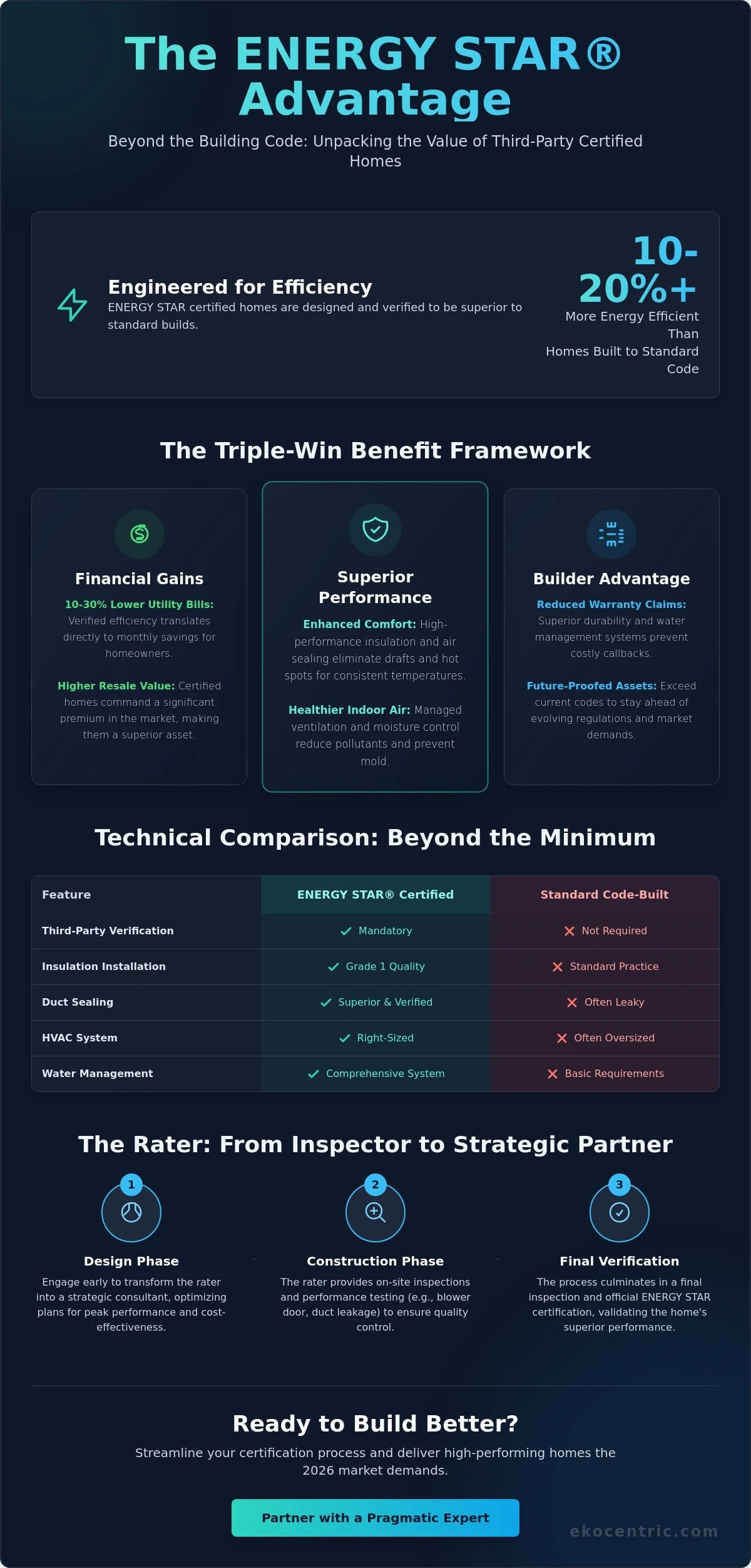
Standard building codes provide a baseline for safety, but they don't guarantee peak performance. The technical gap between a code-minimum house and one built to ENERGY STAR Version 3.1 or 3.2 standards is substantial. One of the primary benefits of ENERGY STAR certified homes is the shift from viewing a house as a collection of parts to treating it as an integrated system. When components like insulation, windows, and HVAC systems are designed to work together, the home operates with a level of efficiency that standard construction simply can't match.
Insulation Precision: Standard fiberglass installation often results in Grade 3 quality, where gaps and compression reduce the effective R-value by 25% or more. ENERGY STAR requires Grade 1 installation, meaning the insulation is fitted perfectly into the wall cavity with zero gaps or voids.
Airtight Ductwork: In a typical home, 20% to 30% of the air moving through the duct system is lost to leaks. Certified homes must meet strict "tightness" requirements, often limiting leakage to less than 4 cubic feet per minute (CFM) per 100 square feet of conditioned floor area.
Advanced Glazing: While standard double-pane windows are common, certified units use Low-E coatings and argon gas fills. These windows often achieve a U-factor of 0.27 or lower, which significantly reduces the workload on the cooling system during peak summer months.
For builders who don't have the internal bandwidth to manage these technical nuances, professional consulting services can bridge the gap. This ensures every technical requirement is met without slowing down the construction schedule.
Moisture and Durability: The Hidden Advantage
Durability is often overlooked in the energy efficiency conversation. One of the structural benefits of ENERGY STAR certified homes is the mandatory Water Management System Builder Checklist. This requires specific flashing details, heavy-duty drainage planes, and moisture barriers that prevent rot and mold growth. These homes are more resilient against 100-year storm events because they're designed to shed water away from the foundation and wall assemblies effectively. This superior building envelope protects the owner's investment for decades.
Verification Milestones
Accountability is what separates certified homes from those that are merely "built to green standards." Every project undergoes a rigorous two-stage verification process by a third-party HERS Rater. The pre-drywall inspection is the first milestone. It catches thermal bypass issues and framing gaps before they're hidden behind walls. The process concludes with final diagnostic testing, including a blower door test to verify the home's airtightness. Most certified homes must achieve an air exchange rate of 3 air changes per hour (ACH50) or lower, proving the home's performance through data rather than promises.
The Role of the ENERGY STAR Rater in Your Project
To fully realize the benefits of ENERGY STAR certified homes, you need a third-party expert involved before the first shovel hits the ground. An ENERGY STAR Rater isn't just another inspector. They're a specialized consultant who ensures your project meets the rigorous standards set by the EPA. Identifying a Rater during the design phase allows you to optimize building envelopes and HVAC sizing before expensive mistakes are baked into the blueprints. This early collaboration prevents the common "redo" costs that plague projects attempting to add efficiency features as an afterthought.
The Rater bridges the gap between an architect's aesthetic vision and a builder's practical execution. While an architect focuses on form and function, the Rater focuses on the physics of the building. They translate high-level design goals into field-ready instructions for framing and mechanical contractors. By managing the complex documentation and submission process to the EPA, they ensure the official blue label is secured without delaying the closing process or creating administrative bottlenecks for your team.
The Step-by-Step Rater Process
The process begins with Plan Analysis. We use HERS (Home Energy Rating System) modeling software to create a digital twin of your home. This simulation predicts energy performance based on your specific materials and climate zone. Next comes Field Verification. On-site inspections occur at two critical stages. First, the thermal bypass inspection happens before drywall to check insulation and air sealing. Second, a final blower door and duct leakage test confirm the home's airtightness. Once the home passes, the Rater provides the official certificate and thermal enclosure checklist required for labeling.
Why Developers Outsource Sustainability Management
Many developers don't have the internal bandwidth to track every evolving regulation or technical requirement. Since the 2023 update to the Florida Building Code, 8th Edition, staying compliant requires constant vigilance and specialized equipment. Outsourcing this to specialized consultants ensures every project hits its mark without taxing your core team. Understanding the technical benefits of ENERGY STAR certified homes requires a level of expertise that most general contractors aren't equipped to maintain in-house. You can explore our specialized green rater services to see how we provide that additional layer of management for your next project.
Ready to streamline your certification process and ensure peak building performance? Contact our expert team today to integrate professional rating services into your next build.
Future-Proofing and Risk Mitigation for Builders
Building for the future requires more than meeting the bare minimum of today's codes. One of the most overlooked benefits of ENERGY STAR certified homes is the significant reduction in post-construction liability. By 2026, building standards will likely tighten again across the country. Builders who adopt these rigorous protocols now avoid the expensive cycle of callbacks and warranty claims that plague standard builds. A 2023 industry survey showed that HVAC and moisture-related issues account for nearly 75% of construction-related warranty claims. ENERGY STAR's mandated duct leakage and blower door testing catch these failures before the drywall even goes up. This proactive approach saves thousands in remediation costs and protects your reputation.
Third-party verification acts as a "Safe Harbor" during legal disputes. When a HERS Rater validates the HVAC system and building envelope, they create a documented history of performance. This data proves the home was built to exceed standard requirements. It protects your firm from claims of negligence or poor craftsmanship. Staying ahead of local benchmarking mandates is also essential. Many municipalities now require energy performance disclosure at the point of sale. Proactively certifying your projects ensures you aren't caught off guard by shifting regulations. It positions your brand as a leader in sustainable development rather than a follower of minimum requirements.
Adapting to Florida's Unique Environmental Challenges
Florida's climate is notoriously harsh on residential structures. High humidity and salt-air corrosion can degrade standard materials in less than 10 years. The benefits of ENERGY STAR certified homes in this region include enhanced durability through strict moisture management. These standards align closely with FGBC requirements to prioritize resilience. Ekocentric understands how to navigate these Florida-specific codes. We help you select materials that resist moisture intrusion and thermal bridging. This ensures your builds remain resilient against the state's extreme weather patterns and high cooling loads.
The Path Forward: Scaling Sustainability
ENERGY STAR is the perfect foundation for higher-tier certifications. Once your team masters the repeatable process for ENERGY STAR, moving toward LEED BD+C or Net Zero Ready becomes a logical next step. This scalability allows you to standardize green building across entire multi-home developments. Standardizing these practices across a 50-home development reduces the learning curve for subcontractors. It turns sustainability from a complex hurdle into a streamlined, repeatable asset for your business. It creates a predictable timeline and a higher appraisal value for every project in your pipeline.
The transition to greener building doesn't have to be a solo journey. Ready to optimize your workflow? You can revolutionize your building process by partnering with Ekocentric to handle the management of your sustainability goals. We provide the expertise and the bandwidth you need to lead the market in 2026 and beyond.
Securing Your Project’s Future in a Shifting Market
As 2026 approaches, the construction landscape demands higher performance and greater resilience. Builders who prioritize these standards gain a significant competitive edge by delivering properties that are 20% more energy efficient than homes built to the 2021 International Energy Conservation Code (IECC). The benefits of ENERGY STAR certified homes extend beyond utility savings; they represent a commitment to durable construction that withstands Florida's unique humidity and climate challenges. By partnering with experts who hold certifications in LEED, NGBS, and FGBC, you ensure your project meets rigorous technical benchmarks from initial design through final inspection.
Protecting your investment requires more than just meeting today's minimum requirements. It involves anticipating shifts in regional building codes and buyer expectations for healthier, more sustainable living environments. Our team brings an unwavering dedication to environmental stewardship and the technical bandwidth needed to manage complex certification workflows. We're ready to help you navigate these standards with precision and passion. Schedule a consultation with our ENERGY STAR Raters to protect your project’s ROI.
Let's build a more resilient future together.
Frequently Asked Questions
What is the difference between an ENERGY STAR Rater and a HERS Rater?
An ENERGY STAR Rater is a certified HERS Rater who has completed additional EPA-mandated training to verify specific program requirements. While a HERS Rater provides a numerical score based on RESNET standards, the ENERGY STAR professional ensures the home meets 100% of the EPA's rigorous checklists for thermal bypass, HVAC commissioning, and water management. It's a specialized credential that adds an extra layer of oversight to the building process.
How much does it typically cost to certify a home as ENERGY STAR?
Certification costs generally range from $300 to $1,000 per single-family home for the rating and verification services. These figures, reported by industry analysts at Home Innovation Research Labs, cover the mandatory on-site inspections and performance testing required for the label. Builders often find these costs are offset by reduced callback rates and improved construction quality across the project's lifecycle.
Can an existing home be ENERGY STAR certified, or is it only for new construction?
The ENERGY STAR Certified Home label is specifically designed for new construction and homes undergoing gut rehabilitations that can meet Version 3.1 or 3.2 requirements. Existing homeowners who want to improve efficiency should look toward the ENERGY STAR Home Upgrade program. This initiative focuses on six high-impact improvements, such as heat pump installation and attic insulation, rather than the full-home certification reserved for new builds.
How does ENERGY STAR certification impact the resale value of a home?
Research from Freddie Mac in 2022 indicates that energy-efficient rated homes sell for approximately 2.7% more than unrated comparable properties. One of the primary benefits of ENERGY STAR certified homes is this documented market premium, which provides tangible proof of quality to future buyers. This certification acts as a third-party validation that the home's performance exceeds standard building codes.
Do ENERGY STAR homes require special maintenance from the homeowner?
Homeowners don't need specialized technical skills, but they must adhere to a strict schedule for high-performance components like Energy Recovery Ventilators (ERVs). Because these homes are built to be airtight, maintaining the mechanical ventilation system is vital for indoor air quality. This typically involves checking and replacing high-MERV filters every 90 days to ensure the system operates at peak efficiency.
Is ENERGY STAR certification mandatory in Florida for new builds?
ENERGY STAR certification isn't mandatory under the 2023 Florida Building Code, 8th Edition. It remains a voluntary program for builders who want to distinguish their projects in a competitive market. Many developers in the Sunshine State adopt these standards to exceed the baseline energy code by at least 10%, which helps mitigate the impact of Florida's high humidity and cooling demands.
How does ENERGY STAR compare to LEED for Homes?
ENERGY STAR serves as the technical foundation for LEED for Homes, which means a project must meet ENERGY STAR requirements as a prerequisite. While ENERGY STAR focuses strictly on energy, water, and HVAC efficiency, LEED is a broader sustainability framework. LEED awards points for additional categories like sustainable site selection, non-toxic material sourcing, and waste reduction during construction.
What happens if a home fails a Rater's inspection during construction?
If a home fails an inspection, the Rater issues a corrective action report detailing the specific areas that don't meet EPA standards. The builder must remediate these issues, such as sealing duct leaks or fixing insulation gaps, before the Rater performs a follow-up verification. This process ensures that every certified home actually performs as designed, preventing efficiency gaps before the drywall is installed.