What is a LEED Green Rater? The Essential Role in Residential Certification
Could your residential project's sustainability goals fail simply because you hired a consultant instead of a mandatory verifier? Many developers and project leads feel overwhelmed by technical documentation and the distinct roles within the GBCI framework. It is common to feel uncertain about the difference between a LEED AP and the specialized professional required on the job site. Understanding exactly what is a LEED Green Rater is the first step toward ensuring your project actually meets the rigorous standards required for residential certification.
A LEED Green Rater isn't just an advisor; they're the essential, third-party verification link that confirms your building performs as designed. You're likely looking for a way to navigate the transition to LEED v5 or ensure your multifamily project meets the June 30, 2026, registration deadline for v4.1. This guide will clarify the Rater's specific scope, explain why their onsite presence is a non-negotiable requirement for residential projects, and provide a clear roadmap to help you achieve a successful, high-performance certification without the stress of documentation failure.
Key Takeaways
Understand what is a LEED Green Rater and why they serve as the mandatory third-party verifier for every residential project seeking GBCI certification.
Learn how the Rater’s on-site inspections at the mid-point and final stages ensure your high-performance design is actually executed correctly in the field.
Distinguish the technical "boots on the ground" role of the Green Rater from the strategic project management provided by a LEED AP.
Discover how early collaboration with a Rater mitigates construction risks and prevents costly documentation failures before they impact your certification timeline.
Explore the strategic benefits of using a Rater with Florida-specific expertise to bridge the gap between LEED requirements and local FGBC standards.
Table of Contents
Defining the LEED Green Rater: The Third-Party Backbone of Residential Certification
Core Responsibilities: From On-Site Verification to GBCI Submission
LEED Green Rater vs. LEED AP: Understanding the Different Roles on Your Team
How a Green Rater Streamlines Your Residential Construction Process
Strategic Partnerships: Why Your Florida Project Needs a Local LEED Green Rater
Defining the LEED Green Rater: The Third-Party Backbone of Residential Certification
A LEED Green Rater is a highly specialized professional responsible for the on-site verification of residential projects pursuing certification. While many commercial certifications rely heavily on design documentation, residential projects require a physical presence to verify that green building strategies are actually implemented. This individual acts as the technical eyes and ears of the Green Business Certification Inc. (GBCI). By providing independent verification, they ensure that every home meets the rigorous standards of Leadership in Energy and Environmental Design (LEED). When you ask what is a LEED Green Rater, you're looking for the person who ensures your project's sustainable promises become a physical reality.
To better understand the foundation of this credential, watch this helpful video from the GREEN Home Institute:
The role is specifically tied to the LEED for Homes and LEED Multifamily rating systems, including the current v4 and v4.1 standards. With registration for LEED v4 and v4.1 set to close on June 30, 2026, many project leads are currently working closely with Raters to finalize their submissions before the transition to LEED v5. It's helpful to distinguish this role from others in the field. While a standard home inspector focuses on safety and code compliance, and an energy auditor might only look at thermal performance, a Green Rater evaluates a holistic range of categories. These include water efficiency, indoor environmental quality, and sustainable material selection through professional LEED Green Rater services.
The Mandatory Nature of the Role
You cannot achieve a LEED residential certification without a Green Rater. It's a non-negotiable requirement for the program. The Rater works under a LEED Provider, which is an organization that oversees the quality of the Rater's work and submits the final documentation to GBCI. This structure creates a layer of accountability that protects the integrity of the certification. The Rater must remain independent from the design and construction team to avoid any conflict of interest. This independence gives homeowners and developers confidence that the green claims are verified by an unbiased expert.
Professional Credentials and Oversight
Becoming a Rater requires more than just an interest in sustainability. It involves a rigorous GBCI credentialing process, including specific training and a formal examination. To maintain their active status in 2026, Raters must complete ongoing education to stay current with evolving building sciences. The LEED Provider performs a crucial quality assurance role, reviewing a percentage of the Rater's field work and all of their project files. This multi-tiered oversight ensures that the high-performance goals of your project are met with precision and reliability.
Core Responsibilities: From On-Site Verification to GBCI Submission
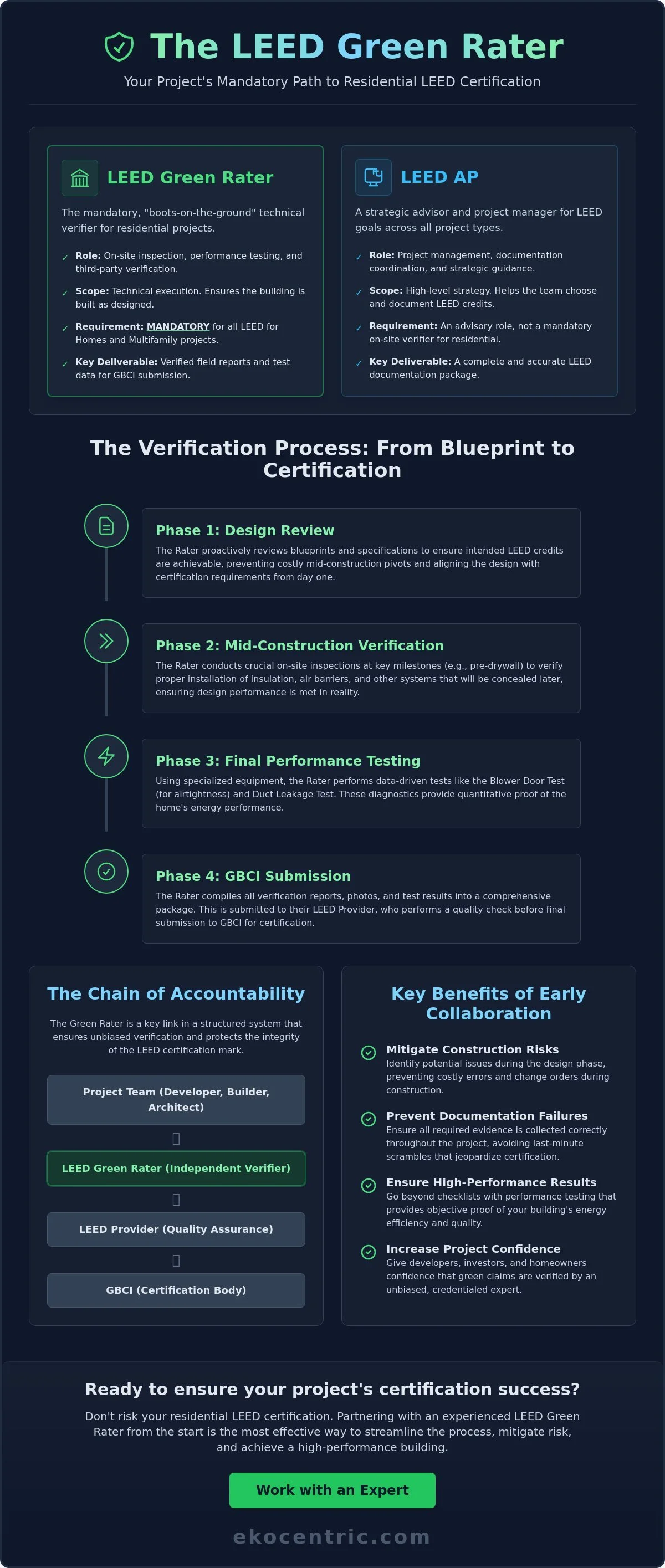
The work of a specialist in this field begins long before construction crews arrive on site. During the design phase, a professional reviews blueprints and specifications to ensure every intended LEED credit is actually achievable within the project's constraints. This proactive approach prevents costly mid-construction pivots that can jeopardize certification. When developers ask what is a LEED Green Rater in a practical sense, the answer lies in their role as a technical gatekeeper. They translate high-level sustainability goals into concrete, verifiable actions that contractors can follow on the ground.
Rigorous performance testing is perhaps the most critical aspect of the Rater's toolkit. Unlike standard home inspections, these evaluations use specialized equipment to provide data-driven results. They conduct blower door tests to measure building envelope airtightness and duct leakage testing to ensure HVAC systems aren't wasting energy. Airflow measurements at exhaust fans and supply registers confirm that the indoor environmental quality meets the strict benchmarks established in the LEED Green Rater Candidate Handbook. These tests transform theoretical efficiency into proven performance.
The Verification Workflow
The verification process follows a strict timeline. During the pre-drywall inspection, the Rater examines insulation installation, framing, and air sealing details that will soon be hidden from view. This is the only opportunity to verify that the thermal bypass checklist is followed correctly. Later, the final inspection involves testing all plumbing fixtures for flow rates and verifying that the installed appliances match the specified energy models. A crucial ethical boundary exists here: the "Conflict of Interest" rule. A Rater identifies non-compliance but cannot perform the repairs themselves. This maintains the integrity of the third-party verification process. If your team needs a dedicated partner to manage these site visits, professional LEED Green Rater services provide the necessary oversight to keep your project on track.
Documentation and GBCI Liaison
Beyond the physical inspections, the Rater manages a mountain of evidence required for final certification. They collect and review contractor affidavits, material receipts, and photos to prove that low-VOC paints or sustainably sourced woods were actually used. This data is then meticulously organized and uploaded to LEED Online or the Provider's portal. When GBCI auditors have questions, the Rater handles all "Requests for Information" (RFIs). They act as the primary liaison between your project and the certifying body, ensuring that every technical detail is defended with evidence. This administrative expertise is what ultimately secures the final certification plaque for your residential building.
LEED Green Rater vs. LEED AP: Understanding the Different Roles on Your Team
Confusion often arises when assembling a project team because both roles share the "LEED" prefix. However, their functions are fundamentally different. A LEED Accredited Professional (AP) serves as your strategic consultant and project administrator. They manage the overall scorecard, coordinate with architects, and handle the bulk of the administrative paperwork. In contrast, the Green Rater is your technical auditor. When you ask what is a LEED Green Rater, think of them as the inspector who physically confirms that the sustainable designs drafted by the AP are actually built. They provide the "boots on the ground" verification that residential projects require.
GBCI usually prevents a LEED AP from serving as the Green Rater on the same project to maintain strict third-party independence. This separation of powers ensures that the person verifying the work isn't the same person who designed the strategy. According to the official LEED for Homes FAQ, this distinction is vital for maintaining the integrity of the residential certification process. While the AP guides the team, the Rater provides the unbiased evidence that the building meets the program's technical requirements.
Strategic Planning vs. Technical Audit
The LEED AP focuses on the "how" and "why" of the project's sustainability goals. They help the team select credits that align with the developer's budget and vision. The Rater focuses on the "is it there?" and "does it work?". They provide the objective proof required by USGBC through physical measurements and visual inspections. The LEED AP designs the sustainable roadmap, while the Green Rater verifies that the project successfully arrived at its destination.
When to Hire Each Professional
Timing is everything for a smooth certification. You should hire a LEED AP during the feasibility stage to determine if certification is viable and to set the project's trajectory. Onboarding the Green Rater happens slightly later but is no less critical. You need them on the team before construction documents are finalized. This allows the Rater to review the specs for technical errors that could lead to failed inspections later. Ekocentric's holistic services bridge both needs, providing the strategic foresight of a consultant and the technical precision of a verifier. This partnership ensures your residential project moves from design to certification without the friction of misaligned expectations.
How a Green Rater Streamlines Your Residential Construction Process
Hiring a professional for this role transforms certification from a bureaucratic hurdle into a streamlined quality control system. Developers often ask what is a LEED Green Rater in the context of their project's bottom line. The answer is that they act as a technical insurance policy against non-compliance. By identifying non-compliant materials or improper installation techniques before they are buried behind drywall, they prevent expensive remediation. This proactive oversight significantly reduces the likelihood of stressful GBCI audit delays, ensuring a much smoother path to final certification and occupancy.
The presence of a rater also provides the verified data necessary to support "green" marketing claims with absolute confidence. In a market where buyers and renters are increasingly skeptical of "greenwashing," having a third-party verification package is a powerful asset. It allows developers to prove that their buildings meet the 2025 and 2026 standards for energy efficiency and resource conservation. This transparency builds trust with investors and future residents alike, positioning the project as a premium, high-quality offering in a competitive landscape.
Preventing Costly Mid-Construction Errors
One of the most common pitfalls in LEED residential projects is the failure to document hidden assemblies correctly. Raters use the mandatory "Thermal Enclosure Checklist" to catch gaps in air sealing or insulation that could lead to future moisture issues and structural degradation. Early involvement allows the rater to guide the construction team through these technical requirements during the framing stage. This saves developers significant capital by catching errors when they only cost minutes to fix, rather than thousands of dollars in retrofits after the building is finished.
Maximizing Building Performance
A certified home must do more than look sustainable; it must perform. Raters verify energy efficiency targets through physical testing, which translates directly to lower utility bills for future residents. This verified performance also extends to indoor air quality, where rater-confirmed ventilation rates protect resident health from pollutants and allergens. Independent rater verification safeguards the asset's long-term ROI by ensuring the building's high-performance features remain durable and efficient throughout its lifecycle. To ensure your next project avoids these common pitfalls, consider partnering with an expert for LEED Green Rater services today.
Strategic Partnerships: Why Your Florida Project Needs a Local LEED Green Rater
Geography fundamentally dictates building science. A residential project in the Pacific Northwest faces entirely different environmental stressors than a multifamily development in Miami or Orlando. In our region, the primary enemies of building longevity are extreme humidity, salt air, and intense solar heat gain. When you consider what is a LEED Green Rater for a Florida build, you must view them as a climate specialist. A local rater understands the nuances of the Southeast's building envelope requirements and ensures that your project doesn't just meet a global standard, but thrives in a tropical environment. Their physical proximity allows for the frequent on-site verification visits necessary to catch moisture management issues before they become permanent liabilities.
Florida developers often find that a single certification isn't enough to satisfy stakeholders or local resilience goals. This is where crossover expertise becomes invaluable. A professional who understands both LEED and Florida Green Building Coalition (FGBC) standards can provide a unified verification path. FGBC is specifically tailored to our state's unique challenges, such as hurricane mitigation and aggressive water conservation. By partnering with a rater who speaks both technical languages, you eliminate redundant inspections and ensure your project captures every possible efficiency credit without doubling your verification costs.
Climate-Specific Verification
Florida's energy codes are uniquely rigorous regarding latent cooling loads. A local rater verifies that high-performance dehumidification and cooling systems are sized and installed to handle our specific climate without over-cycling. They also bridge the gap between hurricane-resilient construction and sustainable design. For instance, ensuring that impact-resistant windows and reinforced masonry also contribute to the project's thermal performance goals. This specialized knowledge prevents the technical friction that often occurs when using national consultants who aren't familiar with Florida's specific energy code vs. LEED requirements.
The Ekocentric Advantage
We are mission-driven advocates for a more resilient and environmentally conscious Florida. Our team doesn't just provide a service; we act as a pragmatic partner invested in the long-term success of your residential asset. We understand the pressure of meeting GBCI requirements while managing tight construction timelines. By simplifying the complex certification landscape, we allow your team to focus on building while we handle the technical proofs. Our deep roots in the state's green building community ensure your project is positioned as a leader in sustainability. Partner with Ekocentric for your LEED Green Rater and BD+C needs to ensure your next project is built for the future of Florida.
Building a Resilient Residential Future
Achieving residential certification requires more than just a sustainable vision; it demands verified performance. By now, you have a clear understanding of what is a LEED Green Rater and why their technical oversight is the mandatory bridge between your blueprints and a certified, high-performance home. Their role ensures your project avoids costly documentation failures while meeting the rigorous GBCI standards required for both LEED for Homes and Multifamily projects. This technical gatekeeping is what ultimately protects the integrity of your investment and the health of the occupants.
At Ekocentric, we bring specialized expertise in LEED BD+C and residential certification to every project, with a dedicated focus on solving Florida's unique humidity and heat challenges. Our mission-driven advocacy for a sustainable future means we're not just auditors; we're your pragmatic partners in building longevity and resource efficiency. We understand the operational realities of developers and provide the technical precision needed to navigate complex certification requirements. Schedule a consultation for your LEED Green Rater services today to secure your project's certification success. Your commitment to environmental stewardship is achievable with the right technical team by your side.
Frequently Asked Questions
Is a LEED Green Rater mandatory for all LEED projects?
A LEED Green Rater is only mandatory for residential rating systems, including LEED for Homes and LEED Multifamily projects. Commercial certifications like LEED BD+C for office buildings or retail spaces use a different verification path that doesn't require a Rater's physical on-site presence. If your project involves dwelling units, you must hire a Rater to achieve GBCI certification.
How much does a LEED Green Rater service typically cost?
Service fees vary based on the project's geographic location, the total number of residential units, and the complexity of the building systems. Larger multifamily developments often benefit from economies of scale during the inspection process. You should request a custom proposal early in the design phase to ensure these essential verification costs are included in your project's soft cost budget.
Can a LEED Green Rater also be the HERS Rater for the same project?
Yes, a single professional often holds both credentials and performs both roles simultaneously to increase efficiency. Since LEED for Homes heavily relies on the HERS Index for energy performance credits, having one person manage both sets of inspections reduces scheduling conflicts and streamlines documentation. This dual role ensures that the energy model and the physical green building requirements remain perfectly aligned.
What happens if a project fails a Green Rater's on-site inspection?
If a project fails an inspection, the contractor must remediate the non-compliant items before the Rater conducts a re-inspection. For example, if the Rater finds gaps in the air sealing during a pre-drywall visit, the crew must seal those areas before the drywall is installed. Timely remediation is crucial because once certain building components are covered, they can no longer be verified, which might jeopardize specific LEED credits.
How do I find a qualified LEED Green Rater in Florida?
You can find qualified professionals by searching the official GBCI directory or by partnering with local firms that specialize in the Southeast's unique building science. It's vital to choose a partner who understands exactly what is a LEED Green Rater in the context of Florida's humidity and high-velocity hurricane zones. Local expertise ensures that your project meets both national standards and specific regional resilience requirements.
What is the difference between a LEED Green Rater and a LEED AP Homes?
The LEED AP Homes acts as a strategic consultant who manages the project's overall points and administrative submission. The Green Rater is the technical auditor who must physically visit the job site to verify that the sustainable features are actually installed. While the AP focuses on the certification roadmap, the Rater provides the objective evidence that the project reached its destination.
Does a Green Rater help with the 45L tax credit?
Our primary focus is on delivering technical certification and high-performance building verification rather than managing financial incentive programs. Many federal and state tax programs, such as the 45L credit, are set to expire or undergo significant changes by the summer of 2026. We prioritize ensuring your project meets the long-term durability and efficiency standards of LEED and FGBC certification.
Can a Green Rater provide design advice during the project?
A Green Rater must remain an independent third party and cannot provide design advice or perform construction work on the project they are verifying. Providing design solutions would create a conflict of interest and violate GBCI's ethical standards. They can, however, identify when a design or installation doesn't meet the LEED requirements, allowing your design team to create the necessary corrections.