Green Affordable Housing: Florida Housing Coalition Guide
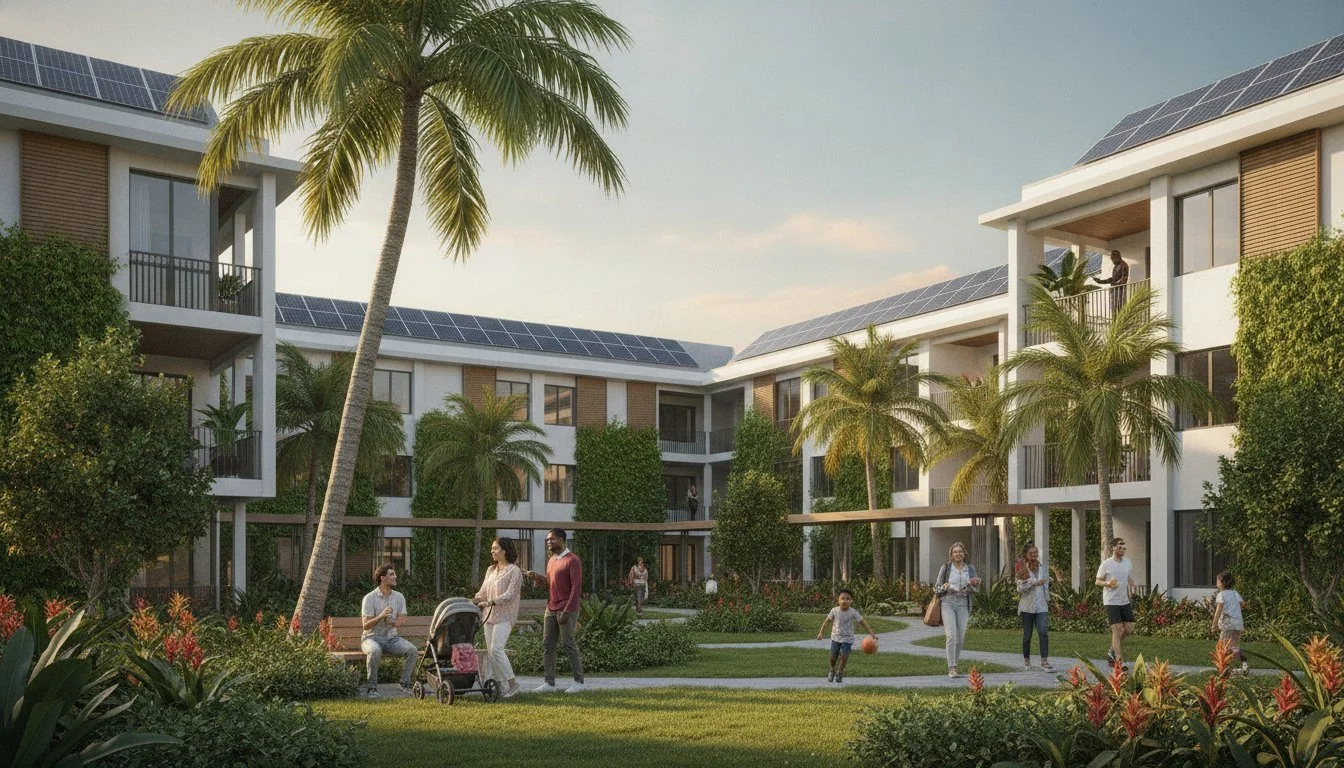
After spending the beginning of the week at the Florida Housing Coalition REPAIR event, it has become even more apparent that there continues to be an afforable housing crisis in Florida and around the country. Building affordable housing that remains truly affordable for the long haul requires more than just low initial rents; it demands a radical commitment to building performance. You likely feel the pressure of balancing energy efficiency with strict budget constraints, often fearing that specialized materials or complex certification paperwork will blow your margins. It's a common struggle, but mastering Affordable Housing and Green and Sustainable Building referencing the Florida Housing Coalition standards provides a clear roadmap for success. Discover how developers leverage these standards and green certifications to build resilient, cost-effective, and healthy affordable housing.
Whether your project is in Florida, Georgia, South Carolina, or North Carolina, these practices are essential for securing funding by meeting "Go Green" requirements. We'll examine how certifications like LEED, NGBS, and FGBC create healthier living environments for vulnerable populations while lowering long-term operational costs. From national projects to international developments, this guide outlines how to turn complex environmental goals into pragmatic, high-quality living spaces that serve both the mission and the bottom line.
Key Takeaways
Learn how to prioritize actual building performance so you don't just chase points but create truly healthy, efficient living spaces.
Identify whether NGBS, LEED, or FGBC is the right fit for your project to maximize operational savings and meet "Go Green" funding requirements.
Align your development strategy with the latest frameworks for Affordable Housing and Green and Sustainable Building referencing the Florida Housing Coalition to streamline funding and compliance.
Access specialized consulting that scales with your needs, supporting projects across Florida, Georgia, and the Carolinas, as well as nationwide and international locations.
Avoid expensive mid-construction errors by integrating expert green verification early in the design process to bridge the gap between technical standards and architectural vision.
Table of Contents
The Intersection of Affordability and Sustainability in 2026
Navigating the Florida Housing Coalition Sustainable Design Framework
Strategies for Optimizing Building Performance and Resident Health
The Intersection of Affordability and Sustainability in 2026
Green affordable housing isn't about luxury finishes or high-end aesthetics. It's about a disciplined approach to capital allocation that prioritizes the long-term health of both the building and its residents. Developers often struggle to balance high upfront costs with the need for operational savings, but the two are not mutually exclusive. By 2026, the building industry in the Southeast will reach a tipping point where sustainable standards become the baseline for financial viability. The Florida Housing Coalition (FHC) leads this charge, positioning environmental stewardship as a core component of housing stability. Integrating Affordable Housing and Green and Sustainable Building referencing the Florida Housing Coalition guidelines ensures that projects remain durable while serving the most vulnerable populations.
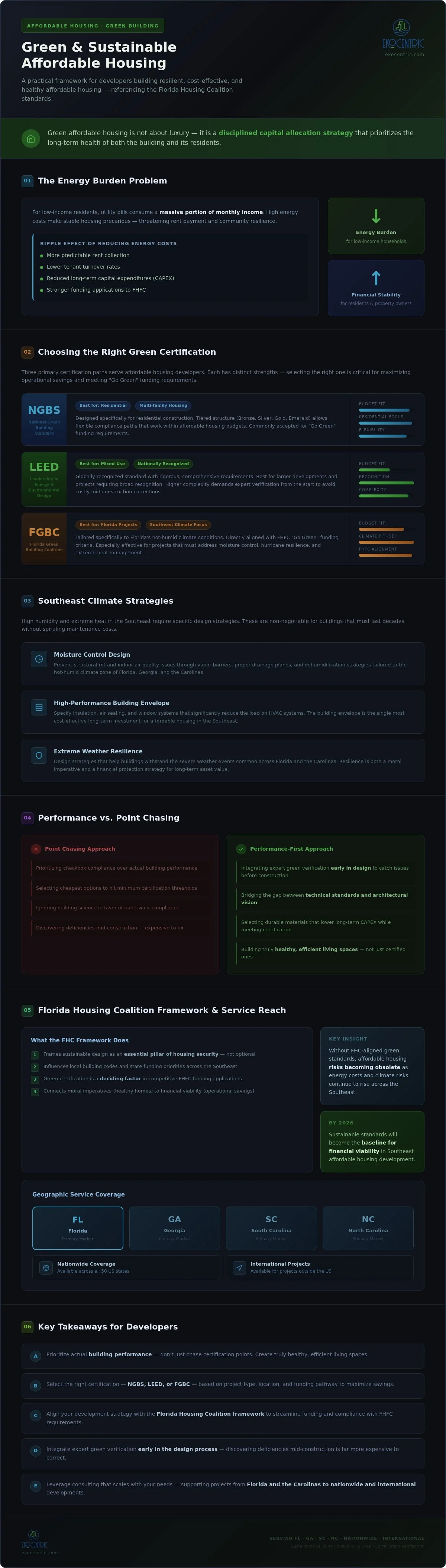
Sustainable building directly addresses the "energy burden" that plagues low-income households. For these residents, utility bills can consume a massive portion of their monthly income. By reducing these costs through better performance, we don't just save energy; we increase a resident's ability to pay rent and maintain a stable home. This creates a more reliable revenue stream for property owners and a more resilient community for everyone.
Economic Benefits of Green Affordable Housing
Lowering utility costs has a direct ripple effect on property management. When residents aren't struggling with massive electric bills, rent collection becomes more predictable and turnover rates drop. Beyond the resident's wallet, using durable, green materials lowers long-term capital expenditures (CAPEX). These choices make a project significantly more attractive to the Florida Housing Finance Corporation. Meeting "Go Green" requirements is often the deciding factor in securing funding. Whether you are working in Florida, Georgia, or the Carolinas, these specialized services ensure your project meets the necessary thresholds for success without overextending your budget.
Addressing the Southeast Climate Challenge
The climate in the Southeast presents unique hurdles that demand expert attention. High humidity and extreme heat require specific design strategies to prevent mold and ensure resident comfort. Resilience isn't just a buzzword; it's a requirement for physical survival. While our work extends across the United States and even to international projects, the lessons from the Southeast climate are universal. Protecting the building envelope is the most effective way to ensure a multi-family unit lasts for decades. Consider these critical strategies:
Designing for moisture control to prevent structural rot and indoor air quality issues.
Specifying high-performance building envelopes to reduce the load on HVAC systems.
Implementing resilience strategies that help buildings withstand the extreme weather events common in Florida and the Carolinas.
By focusing on actual building performance rather than just "point chasing," developers can ensure their Affordable Housing and Green and Sustainable Building referencing the Florida Housing Coalition projects stand the test of time.
Navigating the Florida Housing Coalition Sustainable Design Framework
The Florida Housing Coalition (FHC) doesn't just suggest green building; it frames it as an essential pillar of housing security. Their advocacy focuses on the intersection of environmental health and economic stability. By influencing local building codes and state funding priorities, the FHC has made sustainable design a requirement for competitive projects. This framework bridges the gap between high-level policy and the physical construction of Affordable Housing and Green and Sustainable Building referencing the Florida Housing Coalition. The "imperative" the Coalition speaks of is both moral and financial. Without these standards, affordable housing risks becoming obsolete as energy costs and climate risks rise across the Southeast.
While the FHC framework originated in Florida, its influence now shapes standards across Georgia and the Carolinas. It serves as a benchmark for developers who want to ensure their projects are resilient enough to handle our regional climate while remaining financially viable. This policy connection is vital because it often dictates which projects receive the highest scoring in competitive funding rounds. Aligning your project with these mandates isn't just about compliance; it's about future-proofing your investment.
Key Pillars of the FHC Sustainability Vision
The FHC vision rests on three core technical areas: energy efficiency, water conservation, and indoor air quality (IAQ). These aren't just for points. They're for people. High IAQ standards reduce respiratory issues for residents, which is a critical component of social equity. Site selection and transit-oriented development (TOD) are also prioritized. This ensures residents aren't isolated from jobs, health care, and grocery stores, effectively lowering their total cost of living. The goal is to ensure that the benefits of high-performance buildings—like lower utility bills and better health—reach the populations that need them most. This holistic approach ensures that "green" isn't a luxury, but a standard for everyone.
From Policy to Practice: The Developer’s Roadmap
Moving from a high-level policy to a finished building requires a clear strategy. Successful developers align their project goals with FHC recommendations during the initial design phase. This early alignment makes it easier to identify funding sources that prioritize green-certified projects. You'll also need to coordinate with local municipalities to ensure your design meets specific sustainability benchmarks. If you're feeling overwhelmed by these requirements, our team provides National Green Building Standard Green Verification to help you stay on track and ensure your project meets every technical requirement. This proactive approach prevents costly delays and ensures your project delivers on its promise of long-term affordability.
Whether you're working on a multi-family unit in Florida or a large-scale development in North Carolina, the roadmap remains the same. Start with the policy, identify your certification pathway, and integrate technical verification from day one. This process transforms abstract sustainability goals into a tangible, high-performing reality for your residents and your stakeholders.
Choosing the Right Certification: NGBS vs. LEED vs. FGBC
Selecting a certification pathway is one of the most critical decisions in the development process. While many organizations provide a list of allowed standards, they rarely explain which one offers the best return on investment for specific project types. For developers focused on Affordable Housing and Green and Sustainable Building referencing the Florida Housing Coalition, the choice usually comes down to three main options: NGBS, LEED, or FGBC. Each has distinct advantages depending on your project's location, funding requirements, and long-term goals. Making the right choice early prevents administrative bottlenecks and ensures your project remains financially viable.
NGBS: The Affordable Housing Workhorse
The National Green Building Standard (NGBS), or ICC 700, has become the most popular choice for multi-family affordable housing projects. It's designed specifically for residential builds, making it more intuitive and often more cost-effective than other systems. An NGBS Verifier plays a vital role here. They don't just check boxes; they ensure compliance from the initial design through final occupancy. Scoring categories focus on practical impacts like site development, water efficiency, energy use, and indoor environmental quality. This pragmatic structure allows developers to achieve high levels of performance without the "prestige tax" sometimes associated with other certifications.
LEED and FGBC: When to Choose Them
LEED for Homes and BD+C remain the gold standard for projects seeking international recognition or those backed by specific federal grants. It's a rigorous process that signals a high level of commitment to environmental stewardship. However, the administrative costs and documentation requirements are typically higher than NGBS. On the other hand, the Florida Green Building Coalition (FGBC) offers a pathway tailored specifically to the unique environmental challenges of the Sunshine State. FGBC prioritizes hurricane resilience, moisture control, and native landscaping. If your project is strictly within Florida and you want a standard that addresses local climate risks with precision, FGBC is an excellent choice.
The Value of a Multi-State Approach
Many developers operate across state lines, managing portfolios in Georgia, North Carolina, South Carolina, and Florida. Standardizing your green building practices across these regions creates operational efficiencies. It allows your design and construction teams to master a specific set of standards rather than relearning a new system for every project. Our certification consulting services streamline this cross-border compliance, ensuring your team meets local mandates while maintaining a consistent quality standard. While our core focus is the Southeast, we maintain the capacity to support projects across the entire United States and internationally, providing a scalable solution for growing developers.
Focusing on actual building performance rather than just chasing points ensures your project delivers real value. By choosing the right certification, you protect your margins and provide a superior living environment for your residents.
Strategies for Optimizing Building Performance and Resident Health
Building performance isn't a theoretical concept; it's a measurable reality that defines the success of any development. Moving beyond the habit of "point chasing" for a certification plaque allows developers to focus on the actual longevity and efficiency of the structure. When we implement Affordable Housing and Green and Sustainable Building referencing the Florida Housing Coalition standards, the goal is to create a synergy between low operational costs and high resident well-being. This requires a data-driven approach, using energy modeling and HERS ratings as predictive tools to ensure utility savings are realized from day one. By integrating ENERGY STAR and WaterSense standards, we move from hope-based results to verified performance.
Advanced Building Science for Affordable Units
In the high-humidity environments of Florida, Georgia, and the Carolinas, moisture management is the most critical factor for building durability. It's a direct solution to preventing mold and protecting the structural integrity of the unit. High-performance HVAC systems must balance extreme efficiency with ease of maintenance; complex systems that property managers can't service often lead to failure. We focus heavily on the building envelope, where proper insulation and air sealing significantly impact the HERS Index. A lower HERS score doesn't just mean a more efficient building; it represents a tangible reduction in the "energy burden" for the household. If you need to verify these metrics for your project, our RESNET HERS Rater services provide the technical precision required for compliance and performance.
Health and Wellness in Sustainable Design
Healthy indoor environments are a right, not a luxury. The use of low-VOC materials is a pragmatic choice that directly improves respiratory health for residents, particularly children and the elderly. Indoor Air Quality (IAQ) is a core pillar of sustainable design that often goes overlooked in favor of energy metrics, yet it has a profound impact on resident satisfaction. Biophilic design and natural lighting in common areas aren't just aesthetic choices. These elements create a sense of community and peace, leading to lower turnover and higher pride of residency. The long-term ROI of a healthy building is found in reduced vacancy rates and lower long-term maintenance costs. These strategies ensure that your affordable housing project remains a high-quality asset for decades, serving both the mission and the stakeholders across the United States and international markets.
Optimizing performance requires early-stage planning. When technical building science is integrated into the initial design, the cost of these improvements is minimized while the benefits are maximized. This proactive strategy ensures that every dollar spent contributes to a more resilient, cost-effective, and healthy living environment.
Scaling Sustainable Solutions with Ekocentric’s Consulting
High-level policy from the Florida Housing Coalition is only as good as its execution on the job site. Most developers understand the moral and financial necessity of sustainability, but they often lack the internal resources to manage the technical minutiae of green certifications. We act as the essential bridge between the architect's vision and the rater's requirements. Successfully integrating the principles of Affordable Housing and Green and Sustainable Building referencing the Florida Housing Coalition requires a partner who understands the nuances of both construction and compliance. By engaging in early-stage consulting, you prevent the costly mid-construction changes that often arise when green standards are treated as an afterthought. It's about building it right the first time.
Our role is to translate complex environmental goals into actionable construction steps. This proactive involvement ensures that your project doesn't just meet the minimum requirements but excels in actual performance. Whether you're building in the heart of Florida or expanding into Georgia and the Carolinas, having a technical advocate ensures your sustainability goals remain achievable and affordable.
The LEED Green Rater and NGBS Verifier Advantage
Third-party verification is a non-negotiable requirement for most affordable housing funding streams. It's the only way to prove to stakeholders that a building meets the rigorous standards for energy efficiency and resident health. We don't just review plans; we take a hands-on approach to field inspections and documentation. As a LEED Green Rater and NGBS Verifier, we ensure every detail, from air sealing to HVAC commissioning, aligns with your certification goals. This active oversight keeps your project on track for both its final certification and its scheduled occupancy date. We handle the complex paperwork and technical verification so your team can focus on the broader construction timeline.
Partnering for Performance
We recognize that busy developers face a significant internal capacity gap when it comes to specialized project requirements. Our team steps in to fill that void, providing customized sustainability roadmaps for residential and multi-family projects. We bring a unique dual expertise to the table, operating as both a licensed Florida Certified Building Contractor and a multi-state realtor. This background allows us to optimize building performance while keeping a sharp eye on real estate marketability. It's a pragmatic approach that ensures your "green" project is also a sound financial investment.
While our primary focus remains on Florida, Georgia, South Carolina, and North Carolina, our capacity extends across the entire United States and to international developments. We're dedicated to environmental stewardship and helping you create high-quality living spaces for vulnerable populations. View our full range of green building services to get started on your next project. We're here to ensure your vision of sustainable, affordable housing becomes a high-performing reality that stands the test of time.
Building the Future of Resilient Communities
Building high-quality, high-performance housing isn't just a technical requirement; it's a commitment to the long-term stability of our neighbors. By choosing the right certification pathway and prioritizing indoor air quality over simple "point chasing," developers create assets that stand the test of time. Mastering Affordable Housing and Green and Sustainable Building referencing the Florida Housing Coalition standards ensures your project remains financially viable while providing healthy environments for those who need them most.
We bring a unique, pragmatic perspective to every project as a Licensed Florida Certified Building Contractor and a Licensed Realtor in FL, NC, and SC. Our expertise as an NGBS Green Verifier and LEED Green Rater allows us to bridge the gap between complex policy and on-the-ground construction. Whether you're operating in the Southeast, across the United States, or in international markets, our team is ready to help you optimize building performance. It's time to turn your sustainability goals into a tangible reality. Contact Ekocentric for a Sustainable Building Consultation today to ensure your next development leads the way in resilient, affordable design. We look forward to building a more sustainable future together.
Frequently Asked Questions
Is green building certification required for affordable housing in Florida?
While Florida doesn't have a single universal law for all construction, the Florida Housing Finance Corporation frequently mandates green certifications for projects receiving state funding. Meeting standards like NGBS, LEED, or FGBC is often a prerequisite for a successful funding application. These requirements ensure that public investments result in durable, energy-efficient housing that provides long-term value for residents. We help you navigate these specific mandates to ensure your project remains eligible for essential funding streams.
How does the Florida Housing Coalition influence sustainable building standards?
The Florida Housing Coalition acts as a primary advocate and educational resource, shaping the sustainability agenda for the state's housing sector. They provide the framework and policy guidance that local municipalities and state agencies use to define environmental performance. By emphasizing the intersection of social equity and environmental health, they ensure that Affordable Housing and Green and Sustainable Building referencing the Florida Housing Coalition remains a priority for developers, architects, and policymakers alike.
Can I achieve NGBS or LEED certification for projects outside of Florida?
Yes, both NGBS and LEED are national and international standards that apply to projects regardless of their geographic location. While we have deep roots in the Southeast, our team provides verification and consulting services across the entire United States and for international developments. This allows developers to maintain consistent quality and performance standards across their entire portfolio. It's a pragmatic way to ensure every building meets rigorous energy and environmental benchmarks regardless of the local market.
What is the role of a LEED Green Rater in an affordable housing project?
A LEED Green Rater provides the essential third-party verification required to achieve LEED certification for residential projects. They perform on-site inspections, verify technical building performance, and manage the extensive documentation process required by the USGBC. This role ensures that the building actually performs as designed, protecting the developer's investment and the residents' health. Their oversight is a critical component of securing funding that requires verified green building credentials and high-performance outcomes.
How does sustainable building impact the long-term cost of affordable housing?
Sustainable building significantly lowers long-term operational costs by reducing energy and water consumption through better building science. For residents, this means lower utility bills, which improves their ability to pay rent consistently and maintain household stability. For developers, using durable, green materials reduces maintenance expenses and capital expenditures over the building's lifecycle. These efficiencies ensure the project remains financially viable while providing a stable, high-quality living environment for vulnerable populations across the country.
What are the most cost-effective green certifications for multi-family developers?
The National Green Building Standard (NGBS) is generally considered the most cost-effective pathway for multi-family affordable housing projects. It's designed specifically for residential construction, offering a pragmatic scoring system that focuses on high-impact areas without excessive administrative costs. While LEED and FGBC are excellent options for specific project types, NGBS provides a streamlined approach that balances rigorous performance with the strict budget constraints typical of affordable developments. It's the workhorse of the sustainable housing industry.
Can Ekocentric assist with projects in Georgia, North Carolina, or South Carolina?
Yes, we provide comprehensive green building services throughout Georgia, North Carolina, and South Carolina, in addition to our core Florida market. Our team understands the specific regional climate challenges and funding requirements in these states. We help developers navigate local mandates while achieving national certifications like NGBS or LEED. Our reach also extends nationwide and internationally, supporting sustainable growth and technical building performance wherever your next development project takes you.
What is the difference between an ENERGY STAR Rater and a Green Rater?
An ENERGY STAR Rater focuses specifically on energy efficiency metrics, verifying that a home meets the EPA's strict energy performance guidelines. A Green Rater, such as a LEED Green Rater, has a broader scope that includes energy but also covers water conservation, indoor air quality, site impact, and material sustainability. While both are technical experts, a Green Rater manages the comprehensive certification process for holistic sustainable building programs that look at the entire footprint of the development.