LEED v4 vs. LEED v5: Key Changes & Requirements
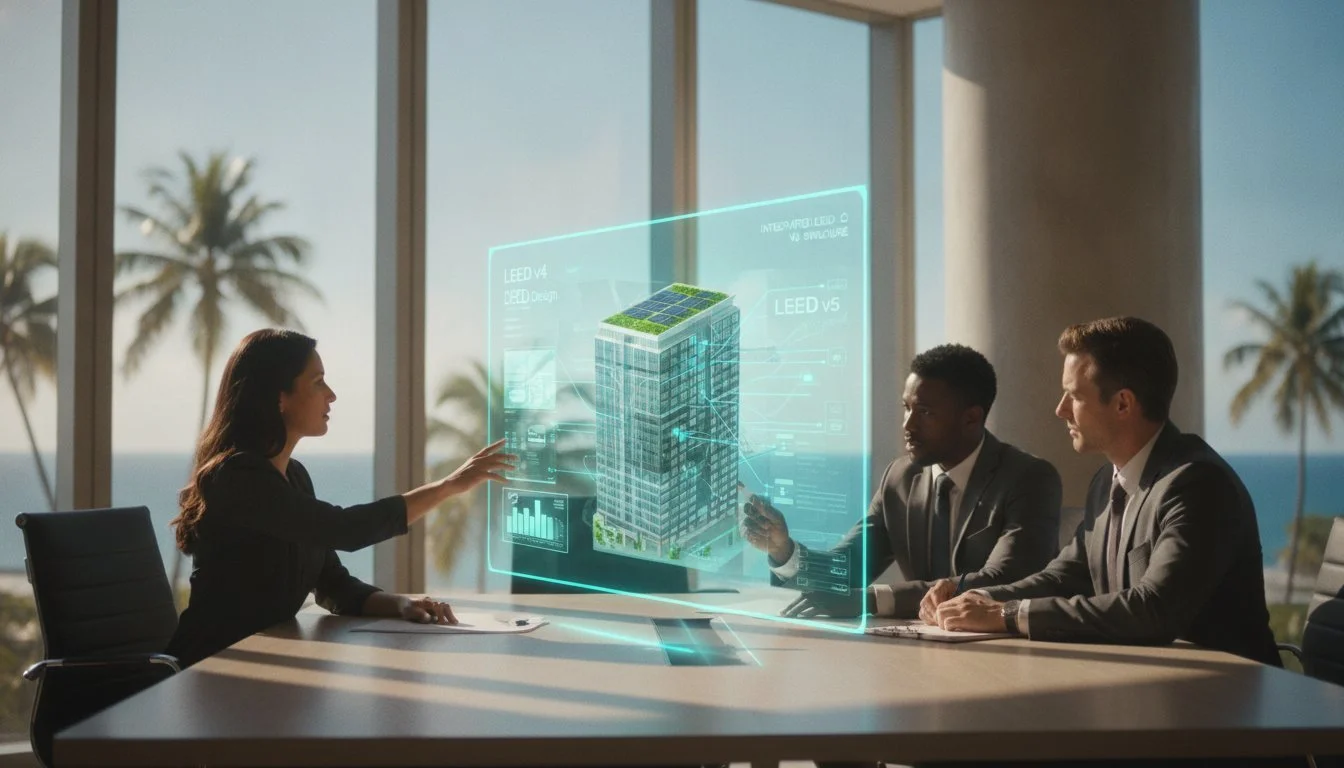
LEED v4 vs LEED v5
Did you know that decarbonization now accounts for a staggering 50% of all available points in the new LEED framework? This isn't just a minor update; it's a fundamental shift in how green building is measured. Understanding the LEED version 4 vs LEED version 5 differences and changes is no longer about checking boxes. It's about a total strategic pivot toward active environmental restoration and resource efficiency.
You're likely feeling the pressure of the June 30, 2026, sunset date for v4 registrations. It's natural to feel anxious about stricter Platinum requirements or how to justify these new standards to your stakeholders when the rules are changing so rapidly. We understand the challenge of managing complex certification goals without enough internal resources. This guide will empower you to master this transition with total confidence. We'll explore the new three-pillar scoring system, identify the must-know credit changes, and provide a clear roadmap to ensure your projects remain at the forefront of the industry.
Key Takeaways
Secure your project's timeline by mastering the June 30, 2026 registration deadline as the industry shifts toward more rigorous standards.
Identify the core LEED version 4 vs LEED version 5 differences and changes, specifically the new 50% scoring weight dedicated to total carbon management.
Master the elevated Platinum threshold, which now requires 80 points plus mandatory minimums in four high-impact technical credits.
Learn how a strategic gap analysis and HVAC electrification evaluation can effectively bridge the divide between current v4 designs and v5 performance goals.
Discover how professional LEED BD+C Consulting and Green Rater services provide the pragmatic expertise needed to achieve certification in a changing landscape.
Table of Contents
The LEED Evolution: Understanding the Transition from v4 to v5 in 2026
The Three Strategic Pillars of LEED v5: Decarbonization, Health, and Ecology
Technical Breakdown: Scoring Adjustments and New Platinum Requirements
Operational Strategy: Preparing Your Project for the LEED v4 Sunset
Partnering for Success: How Ekocentric Navigates the v5 Landscape
The LEED Evolution: Understanding the Transition from v4 to v5 in 2026
The global construction industry is at a critical crossroads. LEED v5 represents a bold leap forward; it's the first rating system developed to align directly with the 2030 and 2050 targets set by the Paris Agreement. While previous versions focused on reducing negative impacts, this new iteration prioritizes active restoration and systemic change. By integrating deep decarbonization and social equity into every credit, the framework is pushing the industry toward a future where buildings contribute positively to their environments. This evolution is particularly critical for the Building Design and Construction (BD+C) market, where long-term asset value is now inextricably tied to environmental resilience. Many professionals rely on Leadership in Energy and Environmental Design (LEED) as the gold standard for these efforts, and v5 raises that bar significantly.
To better understand how these updates will impact your next project, watch this summary of the core changes:
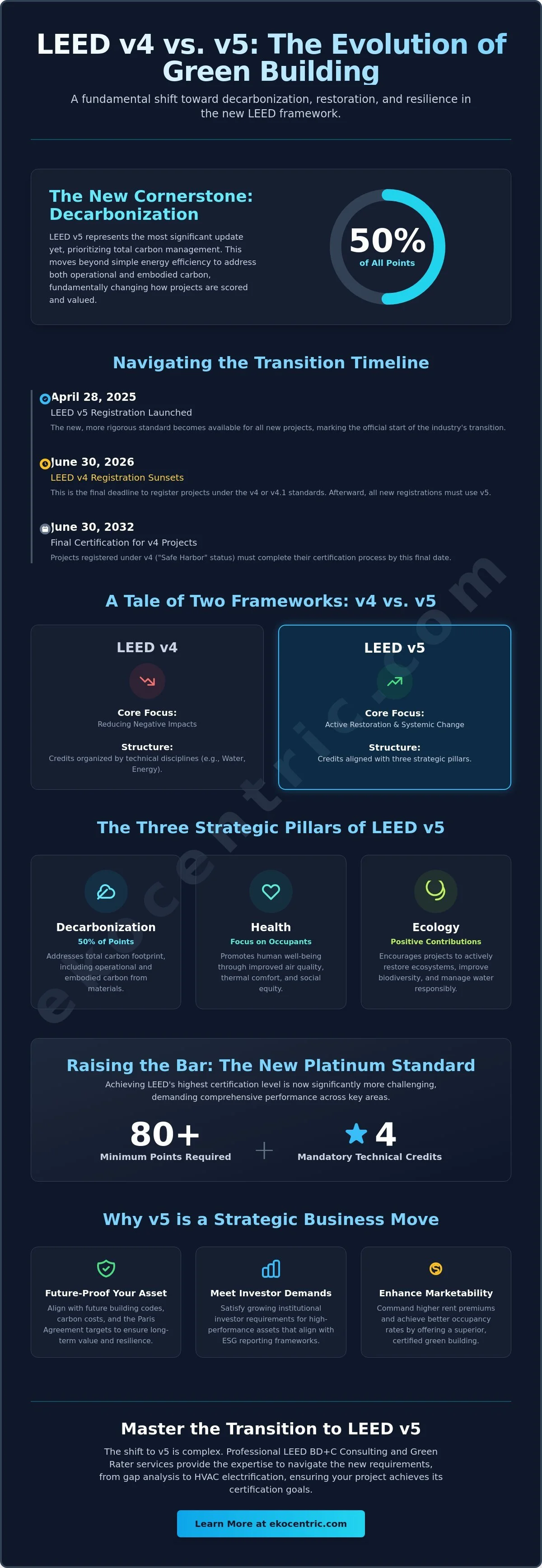
Mastering the LEED version 4 vs LEED version 5 differences and changes requires a close look at the aggressive timeline. Registration for v5 launched on April 28, 2025. This means the window for registering under the older v4 or v4.1 standards is closing fast. The official sunset date for new v4 registrations is June 30, 2026. After this point, the industry moves into a performance-first era that demands more rigorous data and strategy from the outset.
The 2026 Sunset: What v4 Users Need to Know
The June 30, 2026, deadline is a firm cutoff. If your project isn't registered by this date, you'll be required to follow the v5 requirements. For teams currently in the design phase, this creates an urgent decision point. Projects already registered under v4 have "Safe Harbor" status, meaning they can continue under those standards until the final certification sunset on June 30, 2032. However, sticking with the older version might leave your asset behind as market expectations and tenant demands shift toward the more rigorous v5 benchmarks.
Why LEED v5 is a Strategic Business Move
Adopting v5 isn't just about compliance; it's a savvy move for long-term asset longevity. Institutional investors increasingly demand high-performance assets that align with ESG reporting frameworks. By meeting v5 standards, you future-proof your project against stricter local building codes and rising carbon costs. These buildings often command higher rent premiums and maintain better occupancy rates. Because the transition is technically demanding, many developers find that LEED BD+C Consulting is essential to manage the increased complexity without overextending internal teams. Professional guidance ensures your project doesn't just meet the minimums but thrives in this new regulatory environment.
The Three Strategic Pillars of LEED v5: Decarbonization, Health, and Ecology
LEED v5 isn't just a revision; it's a structural reorganization. While v4 categorized credits by technical discipline, like Water Efficiency or Energy and Atmosphere, the official LEED v5 framework centers on three high-impact pillars. This shift ensures every project decision contributes to a larger narrative of global restoration. Understanding the LEED version 4 vs LEED version 5 differences and changes starts with recognizing that these pillars now drive the scoring logic. By aligning every credit with Decarbonization, Health, or Ecology, the system creates a more cohesive strategy for developers and project leads.
Decarbonization: Beyond Energy Efficiency
The most significant change is the transition from simple energy efficiency to total carbon management. Decarbonization now accounts for half of all available points in the certification process. LEED v5 requires teams to account for embodied carbon, which includes the emissions generated during the manufacturing and transportation of building materials. Projects must also demonstrate a clear plan for the phase-out of on-site fossil fuel combustion. Operational carbon serves as a primary metric in v5 scoring, pushing the industry toward all-electric HVAC systems and 100% renewable energy procurement to meet 2030 targets.
Quality of Life and Social Equity
Social equity is no longer an optional "innovation" credit. It's a core requirement for a resilient future. The framework introduces specific credits for social equity within the project team and mandates genuine community engagement during the planning phase. Wellness strategies have also evolved from passive features to active performance. For example, indoor air quality isn't just about filtration; it's about measurable health outcomes that drive tenant productivity and long-term asset value. If you're feeling overwhelmed by these new social mandates, our LEED BD+C Consulting team can help you integrate these requirements into your project's DNA from day one.
Environmental Stewardship and Resilience
Climate resilience is now a prerequisite for all BD+C projects. Teams must conduct thorough assessments for local hazards like extreme heat, flooding, and wildfires. LEED v5 also champions "nature-positive" design, which aims to restore local biodiversity rather than just minimizing site disturbance. Water stewardship has expanded too; it now looks beyond the building's meter to include the impact on the local watershed. This holistic approach ensures that buildings function as part of a healthy, living ecosystem rather than isolated structures. It's a pragmatic response to the increasing environmental volatility that modern developers face.
Technical Breakdown: Scoring Adjustments and New Platinum Requirements
The transition from v4 to v5 marks a definitive end to the era of "point-chasing" via low-impact credits. While LEED v4 allowed for a prescriptive, checklist-oriented approach, the new version demands verified performance. Understanding the technical LEED version 4 vs LEED version 5 differences and changes requires a look at the new point distribution. In v5, 90 points are dedicated to meeting specific performance targets, while only 20 points are available for strategy-based credits. This 90/20 split ensures that certification is earned through measurable results rather than just good intentions.
The most significant technical shift is the weighting of carbon management. Decarbonization now accounts for half of all available points. This isn't just a change in energy modeling; it's a holistic requirement that includes embodied carbon and operational emissions. For developers aiming for the top tier, the "Platinum Threshold" has become significantly more rigorous. It's no longer enough to simply cross the 80-point line. Projects must now meet specific minimums in high-impact areas to qualify for the highest level of certification.
Mandatory Credits for LEED Platinum Projects
To achieve Platinum status under LEED v5, projects must hit 80 points and satisfy mandatory minimums in four technical areas. These include industry-best practices for energy efficiency and the total elimination of on-site fossil fuel combustion, with very limited exceptions for emergency backup. Every Platinum-seeking project must also complete a "Carbon Projection and Decarbonization Plan." This prerequisite requires teams to model future operational carbon emissions over a 25-year timeline. This long-term view transforms the building from a static asset into a dynamic participant in the global energy transition.
Changes in Credit Weighting and Scoring
Several credits from v4 have been consolidated to reduce administrative bloat while increasing technical stringency. The "Decarbonization and Efficiency Plans" credit is now the heaviest-weighted individual credit in the system, worth four points. We've also seen a sharp increase in the value of Lifecycle Assessment (LCA) and Material Transparency. These credits reward projects that quantify and reduce the embodied carbon of their structural and enclosure materials. Additionally, the new "Project Team Equity" credit provides a pragmatic way to score points by ensuring diversity and fair labor practices within the design and construction phases. This technical shift ensures that a high score reflects a truly sustainable and socially responsible project.
Operational Strategy: Preparing Your Project for the LEED v4 Sunset
The June 30, 2026, deadline isn't just a date on a calendar; it's a strategic pivot point for your entire portfolio. Successfully navigating the LEED version 4 vs LEED version 5 differences and changes requires more than just awareness. It demands a structured operational response. If your project is currently in the schematic design phase, you must decide now whether to race for a v4 registration or lean into the performance-driven future of v5. This choice will impact everything from your mechanical specifications to your long-term asset value.
To prepare your team for this transition, follow these five essential steps:
Step 1: Conduct a comprehensive "Gap Analysis" to determine how your current v4 design aligns with v5's heavy weighting on decarbonization and equity.
Step 2: Evaluate the electrification potential of your HVAC and water heating systems to eliminate on-site fossil fuel combustion.
Step 3: Update your material procurement specifications to prioritize options with low-embodied carbon and verified transparency.
Step 4: Engage a LEED Green Rater or BD+C consultant early to model v5's 25-year carbon projection.
Step 5: Finalize your registration strategy before the June 2026 sunset to avoid the risks of a last-minute rush.
Managing the 2026 Transition Timeline
The decision to stick with v4.1 or leap to v5 depends heavily on project maturity. If your design is already 60% complete, registering before June 30, 2026, protects your current budget and specifications. However, for projects still in the early feasibility stages, v5 is the superior move for future-proofing. Waiting until the final weeks of June 2026 to register carries significant risk. Administrative bottlenecks or minor documentation errors could accidentally force your project into v5 compliance without the necessary design adjustments. Early-stage carbon modeling is the only pragmatic way to ensure your project remains competitive in a market that rewards high-performance assets.
Procurement and Material Selection in v5
Material selection in v5 moves beyond simple recycled content. You must now vet suppliers for low-embodied carbon and adherence to circular economy principles. This requires a rigorous collection of Environmental Product Declarations (EPDs) that meet the new transparency benchmarks. Transitioning to bio-based materials or products designed for disassembly can earn significant points, but these choices must be made early. Many developers find they lack the internal capacity to manage this complex vetting process. Our team provides specialized material verification support to ensure your procurement path aligns with the latest standards without slowing down your construction schedule.
If you're ready to bridge the gap between current designs and future requirements, contact us today to start your LEED BD+C Consulting engagement.
Partnering for Success: How Ekocentric Navigates the v5 Landscape
The leap from v4 to v5 is more than a technical hurdle; it's a strategic evolution that requires a partner who understands the business realities of development. As you evaluate the LEED version 4 vs LEED version 5 differences and changes for your next project, the need for precise, third-party verification becomes clear. We position ourselves as your pragmatic partner, turning complex environmental mandates into achievable project milestones. Our team doesn't just consult; we advocate for your project's success by aligning aspirational sustainability with a strong return on investment.
In the new performance-driven era of v5, our LEED Green Rater Services are more vital than ever. Because v5 relies heavily on verified data rather than just design intent, having experts on-site to validate performance is the only way to guarantee compliance. We also bring deep Florida-specific expertise to every engagement. We understand how to navigate the intersection of regional building codes and the rigorous new LEED standards, ensuring your project remains resilient in our unique tropical climate without sacrificing efficiency.
Expert LEED BD+C Consulting
Managing the documentation and verification burden for a v5 project can overwhelm even the most experienced design teams. Our LEED BD+C Consulting streamlines this process by handling the technical heavy lifting from start to finish. We provide the third-party assessment necessary to achieve the new v5 mandatory performance credits, which are now a prerequisite for high-tier certifications. Beyond the points, our expert guidance helps clients qualify for green financing by providing the rigorous certification data that institutional lenders now require. We bridge the gap between your sustainability vision and the practical requirements of the modern financial landscape.
Your Roadmap to Certification
Our process begins with a comprehensive initial consultation where we align your project's specific goals with the new v5 framework. We don't believe in one-size-fits-all solutions. Instead, we offer grounded, practical strategies that reflect our deep commitment to environmental stewardship. We work alongside your team to ensure that every decision, from HVAC electrification to material procurement, contributes to a high-performance asset. If you're ready to master the 2026 transition and lead the market in decarbonization, we're here to guide the way. It's time to build a future that is both ecologically restorative and financially sound.
Schedule your LEED v5 project consultation with Ekocentric today to secure your project's path to success.
Lead the Way in Sustainable Development
Navigating the transition to v5 requires a fundamental shift in mindset from doing less harm to active environmental restoration. You now have a clear roadmap to manage the June 30, 2026, sunset date while embracing the new pillars of decarbonization, health, and ecology. By prioritizing verified performance over simple checklists, your projects will achieve greater asset value and long-term resilience in an evolving market. Understanding the LEED version 4 vs LEED version 5 differences and changes ensures your team is prepared for the technical rigors of the new scoring system and the higher bar for Platinum certification.
Success in this new landscape depends on having a pragmatic partner with specialized expertise. We bring a proven track record in BD+C consulting and specialized LEED Green Rater verification to every project. Our deep knowledge of Florida Green Building Coalition standards allows us to bridge the gap between global benchmarks and regional building realities. We're here to turn your aspirational sustainability goals into tangible business outcomes. Secure your project's future; consult with a LEED v5 expert at Ekocentric today. The future of green building is bright; with the right strategy, your next project can lead the industry toward a truly regenerative future.
Frequently Asked Questions
When does LEED v5 officially replace LEED v4 and v4.1?
LEED v5 becomes the mandatory standard for new commercial registrations on July 1, 2027. However, the transition begins much sooner, as the final day to register a project under LEED v4 or v4.1 is June 30, 2026. This timeline ensures a structured phase-out while allowing projects already in the pipeline to certify under older standards until June 30, 2032.
What are the biggest changes in the LEED v5 scoring system?
The biggest change is the shift toward performance-based outcomes, with decarbonization now representing 50% of the total point value. Unlike previous versions, the scoring system allocates 90 points to measurable performance targets and only 20 points to strategy-based credits. This reorganization emphasizes actual environmental results over prescriptive design choices, creating a more pragmatic link between building operations and global goals.
Is LEED v5 harder to achieve than LEED v4?
LEED v5 is more technically rigorous than its predecessors, particularly for teams seeking Gold or Platinum status. The requirement for verified performance data and mandatory minimums in energy efficiency makes it harder to "point-chase" with low-impact credits. Understanding the LEED version 4 vs LEED version 5 differences and changes is essential for teams to avoid a gap between design intent and final certification.
Can I still register a project under LEED v4.1 in 2026?
Yes, you can register a project under LEED v4.1 until the sunset date of June 30, 2026. After this deadline, the USGBC won't accept new registrations for the older version. Teams should evaluate their project's maturity now to decide if they can meet the v4.1 deadline or if they should pivot to the v5 framework to future-proof their asset.
What are the mandatory credits for LEED v5 Platinum certification?
Platinum certification requires 80 points plus mandatory minimums in four specific technical areas. These include high-tier energy efficiency benchmarks and the total elimination of on-site fossil fuel combustion, with limited exceptions for emergency backup. Additionally, every Platinum project must complete a Carbon Projection and Decarbonization Plan that models operational emissions over a 25-year timeline.
How does LEED v5 address embodied carbon in building materials?
LEED v5 introduces a new prerequisite that requires project teams to quantify and assess embodied carbon in building materials. Points are awarded for conducting a whole-building lifecycle assessment and selecting materials with lower carbon footprints. This shift forces a deeper look at the supply chain and the environmental impact of structural components like concrete and steel during the procurement phase.
What is the role of a LEED Green Rater in the v5 certification process?
A LEED Green Rater provides the essential third-party verification required to prove that a project meets v5’s rigorous performance standards. They conduct on-site inspections and performance testing to ensure that systems function as modeled. This role is critical for navigating the LEED version 4 vs LEED version 5 differences and changes because v5 relies so heavily on field-verified data for final certification.
Does LEED v5 offer any incentives for Florida-based projects?
While LEED v5 is a global standard, its framework aligns perfectly with Florida’s specific climate challenges. The new emphasis on climate resilience credits helps Florida developers address regional risks like extreme heat and flooding. Our team also specializes in Florida Green Building Coalition (FGBC) standards, allowing us to help you integrate LEED v5 requirements with regional certification goals for maximum impact.