Mastering Green Building Certification Process Management

Waiting until the final construction phase to organize your documentation is the fastest way to jeopardize your project's certification and market value. With the global green buildings market projected to reach $676.85 billion in 2026, the pressure to deliver high-performance, resource-efficient assets has never been higher. You've likely felt the exhaustion of documentation fatigue or the anxiety that comes when architects and contractors aren't perfectly aligned. It's a common struggle, but mastering green building certification process management ensures you don't miss critical credits when it's too late to change course.
You deserve a predictable path to certification that enhances building performance and secures financing eligibility without derailing your construction timeline. We believe that environmental stewardship and business success should go hand in hand. In this guide, you'll learn how to streamline complex documentation and coordinate stakeholders for a seamless workflow. We'll explore the transition to LEED v5, the specific benefits of FGBC standards for regional resilience, and the practical steps needed to secure your credentials with confidence.
Key Takeaways
Learn why green building certification process management must begin during the "Green Discovery" phase to prevent vital sustainability goals from being value-engineered out of your project.
Discover the five essential phases of management that bridge communication gaps between architects and contractors, ensuring a predictable path to LEED or FGBC certification.
Understand how expert oversight reduces the "green premium" by identifying efficiencies early, turning complex documentation into a streamlined, results-oriented workflow.
Explore the strategic advantages of Florida Green Building Coalition (FGBC) certification for projects facing unique regional challenges like hurricane resilience and humidity.
Identify why a specialized third-party consultant is vital for navigating the rigorous requirements of LEED BD+C and avoiding the risk of late-stage documentation fatigue.
Table of Contents
What is Green Building Certification Process Management?
Green building certification process management is the systematic coordination of design, documentation, and verification to meet rigorous sustainability standards. In 2026, the industry has undergone a fundamental shift from "accidental sustainability" to "managed certification." Previously, teams might have stumbled into a basic rating by simply following standard building codes. Today, with the launch of LEED v5 and its intense focus on decarbonization and Life Cycle Assessments (LCA), success requires intentionality from day one. This management framework ensures that every design choice contributes to a measurable environmental outcome rather than a hopeful guess.
Success is determined by how well the project lead coordinates key stakeholders, including Owners, Architects, MEP Engineers, General Contractors, and Green Raters. These professionals must navigate various green building certification systems to ensure the final structure performs as promised. Without a centralized management strategy, communication gaps between the design team and the construction crew often result in "documentation fatigue." This is where a dedicated manager becomes the project's most valuable asset, ensuring that sustainability goals aren't lost in the chaos of a busy job site.
To better understand how these systems shape the future of construction, watch this helpful video:
The Core Objectives of Certification Management
The primary goal is ensuring absolute technical compliance with standards like LEED BD+C or FGBC. Management creates a robust "Documentation Trail" that serves as the project's environmental proof of performance. By identifying "high-risk" credits early in the design phase, managers prevent the frustration of realizing a building is one point short of its target during the final audit. This foresight protects the owner's investment and the building's long-term market value. If you want to see how these objectives translate into specific project workflows, you can explore our specialized certification consulting services.
Points vs. Checklists: Choosing a Management Strategy
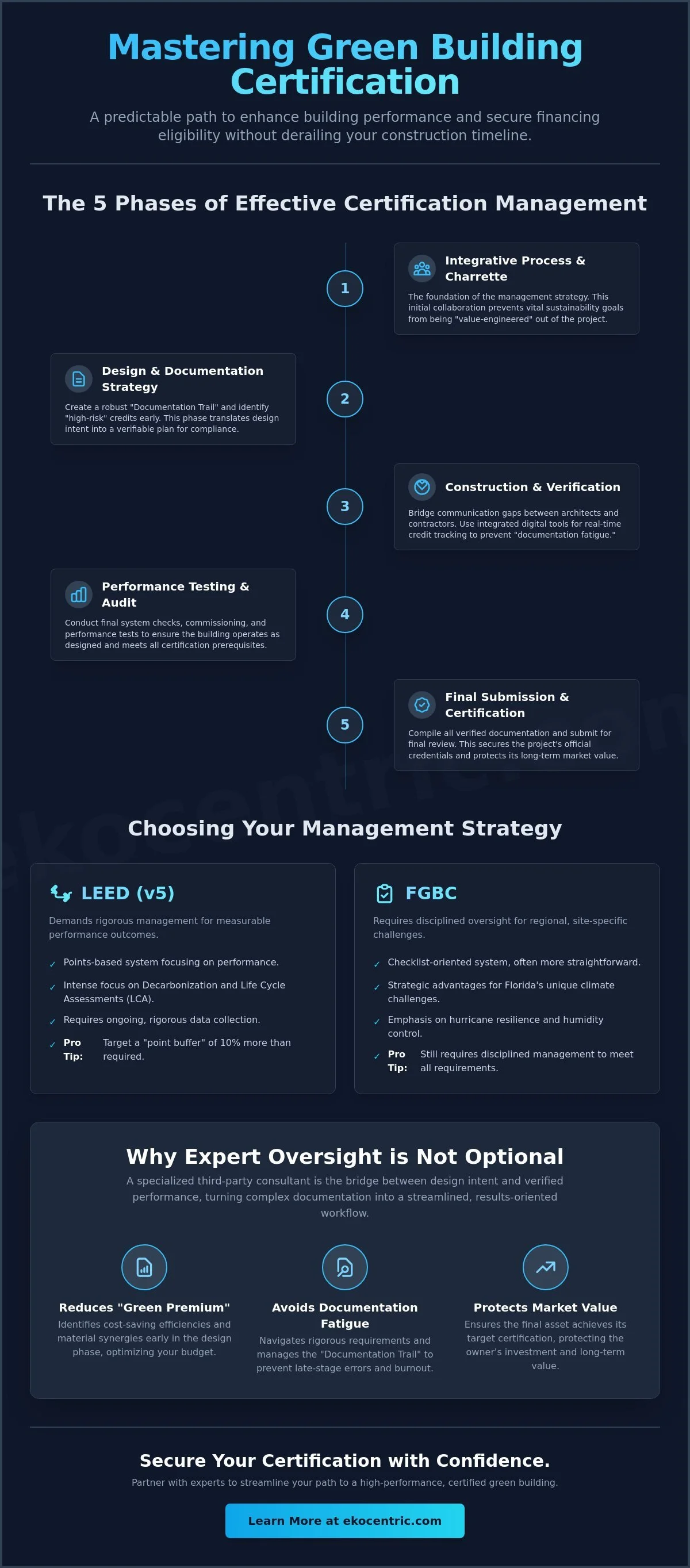
Different systems require distinct management styles. Points-based systems like LEED v5 demand rigorous, ongoing data collection because they focus on measurable performance outcomes like carbon reduction. In contrast, checklist-oriented systems like some FGBC paths might feel more straightforward but still require disciplined oversight to ensure site-specific Florida requirements, such as hurricane resilience, are met. We always recommend maintaining a "point buffer" by targeting 10% more points than the minimum required. This accounts for unforeseen site challenges or documentation rejections. Certification management acts as the essential bridge between design intent and verified performance.
The 5 Phases of Effective Certification Management
Effective green building certification process management is what separates a high-performing asset from a project that merely "tried" to be sustainable. In 2026, we've moved beyond the era of clunky, disconnected spreadsheets. Modern project teams now utilize integrated digital management tools to track credits in real-time, providing a transparent view of progress for every stakeholder. This phased approach is vital because it ensures that essential environmental goals aren't "value-engineered" out of the project when budgets get tight. By treating certification as a core project requirement rather than an optional add-on, you protect the building's future market value and its impact on the planet.
Phase 1: The Integrative Process & Sustainability Charrette
Success begins with the Integrative Process. This isn't just a box to check for a LEED point; it's the foundation of your management strategy. We recommend conducting a Sustainability Charrette before any architectural drawings are finalized. This intensive workshop aligns the owner's vision with technical feasibility and site constraints. During this session, the team sets a preliminary scorecard and assigns specific "credit owners." When an MEP engineer or architect knows exactly which credits they are responsible for from day one, the entire workflow becomes more disciplined and predictable.
Phase 2 & 3: Design Documentation and Construction Oversight
Managing the transition from design intent to physical construction is where many projects stumble. A proactive manager handles the "Design Review" submission to GBCI or FGBC mid-project to secure preliminary approval on design-based credits. This significantly reduces late-stage risk. Once construction begins, the focus shifts to on-site oversight. The management team must ensure the General Contractor strictly adheres to the Indoor Air Quality (IAQ) and Construction Waste Management plans. For residential developments, having a LEED Green Rater on-site is essential for verifying that high-performance features are installed correctly. If you're looking to bridge the gap between design and job-site execution, our specialized consulting services can provide the oversight you need.
Phase 4 & 5: Verification, Submission, and Post-Occupancy
The final phases involve gathering "as-built" documentation, including material receipts and photographic evidence of compliant installations. A well-managed project avoids the end-of-construction scramble by collecting this data incrementally. This preparation allows the team to respond to auditor "Review Comments" with speed and precision. In 2026, the process extends beyond the certificate on the wall. Post-occupancy management now involves monitoring actual performance data. This ensures the building operates as efficiently as intended, providing the necessary metrics for future recertification and proving the long-term ROI of your sustainability investment.
Overcoming Common Management Pitfalls and Objections
The most frequent failure in green building certification process management is treating the rating system as a "bolt-on" at the end of construction. When sustainability is a reactive afterthought, the project inevitably faces higher costs and missed opportunities. This fragmented approach often leads to a "Communication Gap" where the design team's intent is lost by the time the field crew begins installation. Success requires that every stakeholder understands that certification is a core project requirement, not an optional decoration added during the final punch list.
Another significant risk to your project's success is "Credit Drift." This occurs when a project steadily loses points during construction because a subcontractor substitutes a specified material for a non-compliant alternative to save time. Without active management, these small, unauthorized changes can aggregate and cause a project to fall below its target certification level. Managing this drift requires constant vigilance and a clear line of communication between the project manager and the field crew to ensure that every material used meets the original sustainability criteria.
The Reality of the 'Green Premium' in 2026
Many developers still fear the "green premium," yet the true cost often lies in poor process management rather than the materials themselves. By implementing a rigorous management framework from the start, teams can secure specialized financing and improved insurance rates that offset initial investments. Industry data suggests that early management intervention can reduce certification-related soft costs by up to 50%. This efficiency proves that a dedicated commitment to environmental stewardship is a financial asset that increases long-term market value.
Strategies for Documentation Efficiency
Speeding up the submission to GBCI or FGBC requires standardizing requirements for subcontractors early in the bidding process. By including green building criteria in the initial bid packages, you ensure that every partner understands their documentation responsibilities before they step on-site. This proactive stance eliminates the end-of-project scramble for receipts and material safety data sheets. Using established "Project Templates" further accelerates this workflow, preventing the documentation fatigue that often plagues complex developments.
Many organizations find they lack the internal capacity to manage these complex, data-heavy requirements alongside their standard construction duties. This is where Ekocentric consulting services provide an indispensable advantage. We act as your pragmatic partner, bridging the gap between your sustainability vision and the technical realities of the construction site. Our expertise ensures that your project remains on a predictable path to certification without distracting your team from their primary construction goals.
Regional Management: Florida Green Building Coalition (FGBC) vs. LEED
Florida developers face a unique set of environmental challenges that global standards don't always prioritize. While LEED is the most recognized name in sustainability, the Florida Green Building Coalition (FGBC) offers a specialized framework tailored to our state's specific climate risks. Effective green building certification process management requires understanding which of these paths, or perhaps a combination of both, aligns best with your project's goals. Managing for Florida's intense humidity, hurricane resilience, and water scarcity isn't just about earning a plaque; it's about ensuring the long-term durability of your asset in a high-risk environment.
Choosing between these systems often comes down to the target market and the desired level of global prestige. LEED v5 provides a rigorous, data-driven approach to decarbonization that appeals to international investors. Conversely, FGBC focuses on local relevance, emphasizing practices that directly address Florida's unique building codes and environmental conditions. Some forward-thinking teams choose "Dual Certification" to capture the benefits of both. To manage this without doubling your team's workload, you must identify overlapping credits early. A shared documentation strategy allows you to use one set of energy models or water calculations to satisfy both GBCI and FGBC auditors.
Managing FGBC Certification in Florida
The management focus for FGBC is deeply rooted in regional resilience. Unlike the LEED Online portal, the FGBC documentation process is designed to be user-friendly and affordable for local builders. However, it still requires a disciplined hand to coordinate. All homes submitted for FGBC certification must be handled by a Certifying Agent who has completed specialized training. This ensures that the documentation accurately reflects Florida-specific requirements, such as salt-spray resistance or advanced moisture control. Leveraging these local standards in your marketing demonstrates a genuine commitment to the regional environment.
LEED BD+C for Florida Projects
Adapting LEED's energy and water credits to Florida's heat and precipitation patterns requires technical precision. For multifamily residential projects, the role of a LEED Green Rater is indispensable. They provide the on-site verification necessary to ensure that high-performance HVAC systems and building envelopes are installed correctly to combat tropical heat. Managing the relationship between local building inspectors and third-party green raters is a critical task for the project lead. Clear communication ensures that everyone is on the same page regarding the technical requirements for verified performance. If you need expert guidance to navigate these regional complexities, our FGBC and LEED consulting services provide the local expertise your project requires.
Partnering for Success: Why Management Requires Expertise
Relying on internal staff to handle the intricacies of LEED BD+C or FGBC projects often creates a bottleneck that slows down the entire construction schedule. Architects and engineers are highly skilled at their primary roles; however, they shouldn't be expected to manage the relentless administrative requirements of modern sustainability standards. Professional green building certification process management is a specialized discipline that requires a dedicated focus most in-house teams cannot maintain alongside their daily design tasks. By partnering with a dedicated expert, you gain a pragmatic ally who understands both the technical minutiae and your overarching business realities.
A specialized consulting firm provides an essential, objective third-party audit of the entire process. This oversight ensures that every piece of evidence, from energy models to material receipts, meets the rigorous standards of the certifying body before it's submitted. This proactive verification catches potential errors early, saving your team from the frustration of rejected credits and costly late-stage corrections. Beyond the technical benefits, a mission-driven partner acts as a true advocate for your project's environmental goals. We believe that a more sustainable built environment is achievable when expert management bridges the gap between visionary design and verified performance.
The Ekocentric Approach to Certification Management
We act as your "Sustainability Project Manager," taking over the heavy lifting of documentation and stakeholder coordination so your designers can focus on their craft. Our extensive experience includes LEED Green Rater services, National Green Building Standard (NGBS) Green Verification, and FGBC Certification Consulting. We've developed proven workflows that significantly reduce the administrative burden on your project leads. By standardizing the data collection process and providing clear guidance to subcontractors, we ensure that your path to certification is both predictable and efficient.
Next Steps for Your 2026 Project
The most successful projects engage a management consultant before the first drawing is finalized. Early involvement allows us to conduct the Sustainability Charrette mentioned earlier, setting a clear trajectory for the entire build. When evaluating a potential partner, examine their track record with complex projects and their ability to integrate seamlessly into your existing team structure. A reliable partner doesn't just check boxes; they provide the insight and dedication needed to turn your sustainability goals into a high-performance reality that commands higher market value. Closing the loop on certification means moving from a plan on paper to a building that truly performs for its occupants and the planet.
Ready to streamline your build? Explore our Green Certification Services.
Building a Future of Verified Performance
Success in 2026 requires moving beyond a simple checklist approach. It's about implementing an integrative workflow that starts before the first drawing is finalized. We've explored how identifying high-risk credits early and bridging the communication gap between design teams and field crews prevents the "green premium" from eroding your budget. Effective green building certification process management is the essential bridge that turns environmental aspirations into tangible market value and long-term building resilience.
You don't have to navigate these complex technical standards alone. As mission-driven advocates for environmental stewardship, we provide the expert oversight your project deserves. Our team includes specialized FGBC Florida experts and LEED BD+C consultants dedicated to ensuring your build meets the highest efficiency standards without unnecessary delays. We're here to act as your pragmatic partner in creating high-quality, high-performance living spaces.
Ready to secure your project's future? Schedule a Consultation for Your Green Building Project today. Let's build something that lasts for generations.
Frequently Asked Questions
How long does the green building certification process typically take?
The certification timeline typically aligns with your project's full development lifecycle, from the initial pre-design phase through final construction verification. While the formal GBCI or FGBC review period takes several months, the active management of credits happens daily on the job site. Starting during the "Green Discovery" phase ensures that you don't face unexpected delays during the final audit or post-occupancy review.
Is it possible to manage LEED certification without an outside consultant?
While it's technically possible to handle the process internally, most project leads find the administrative burden and technical complexity overwhelming. Professional green building certification process management requires specialized knowledge of evolving standards that change frequently. Engaging an expert prevents the common "documentation fatigue" that often leads to teams missing critical credits late in the construction phase when they're impossible to recover.
What is the difference between a LEED Green Rater and a LEED AP?
A LEED AP is a professional who has passed an exam to demonstrate their knowledge of the LEED rating system. In contrast, a LEED Green Rater is a specialized professional who provides mandatory on-site verification for residential projects. While both roles are vital for success, only the Green Rater can perform the physical inspections and performance testing required for final certification.
Can we get FGBC certification for a project already under construction?
You can sometimes seek FGBC certification mid-construction, but it's significantly more challenging and risky. Many regional requirements involve building features that are buried behind walls or require specific pre-construction planning. If your project has already progressed past the framing stage, we recommend an immediate audit to see which credits are still achievable without costly tear-outs or modifications.
How much does it cost to manage the green building certification process?
Total costs include fixed registration and certification fees paid directly to the governing body. For instance, in 2026, USGBC registration fees range from $1,200 to $2,750 for new construction projects. Beyond these fixed platform fees, management costs vary based on project size and complexity. Investing in professional oversight often pays for itself by identifying efficiencies that lower the overall "green premium" of the build.
What happens if our project fails to meet the required points for certification?
If a project falls short of its point target, the certifying body provides a set of review comments for the team to address. You'll have an opportunity to provide additional documentation or appeal the decision with new evidence. This is why we always recommend targeting a 10% point buffer during the initial design phase to account for potential auditor rejections or site changes.
Does green building certification management help with local Florida building codes?
Yes, certification management often streamlines compliance with local Florida building codes. Because FGBC standards are specifically designed for our state's environment, they often overlap with regional resilience and energy efficiency requirements. This alignment ensures your building is both compliant with local laws and high-performing enough to command a higher market value and better financing eligibility.
How do we manage documentation for LEED BD+C credits?
Managing documentation for LEED BD+C requires a centralized digital tracking system and clear accountability for every team member. We recommend standardizing submittals for subcontractors during the initial bidding phase. This proactive approach to green building certification process management ensures that material receipts and performance data are collected in real-time rather than during a frantic scramble at the end of construction.