Top 5 LEED for Homes in Florida: 2026 Showcase
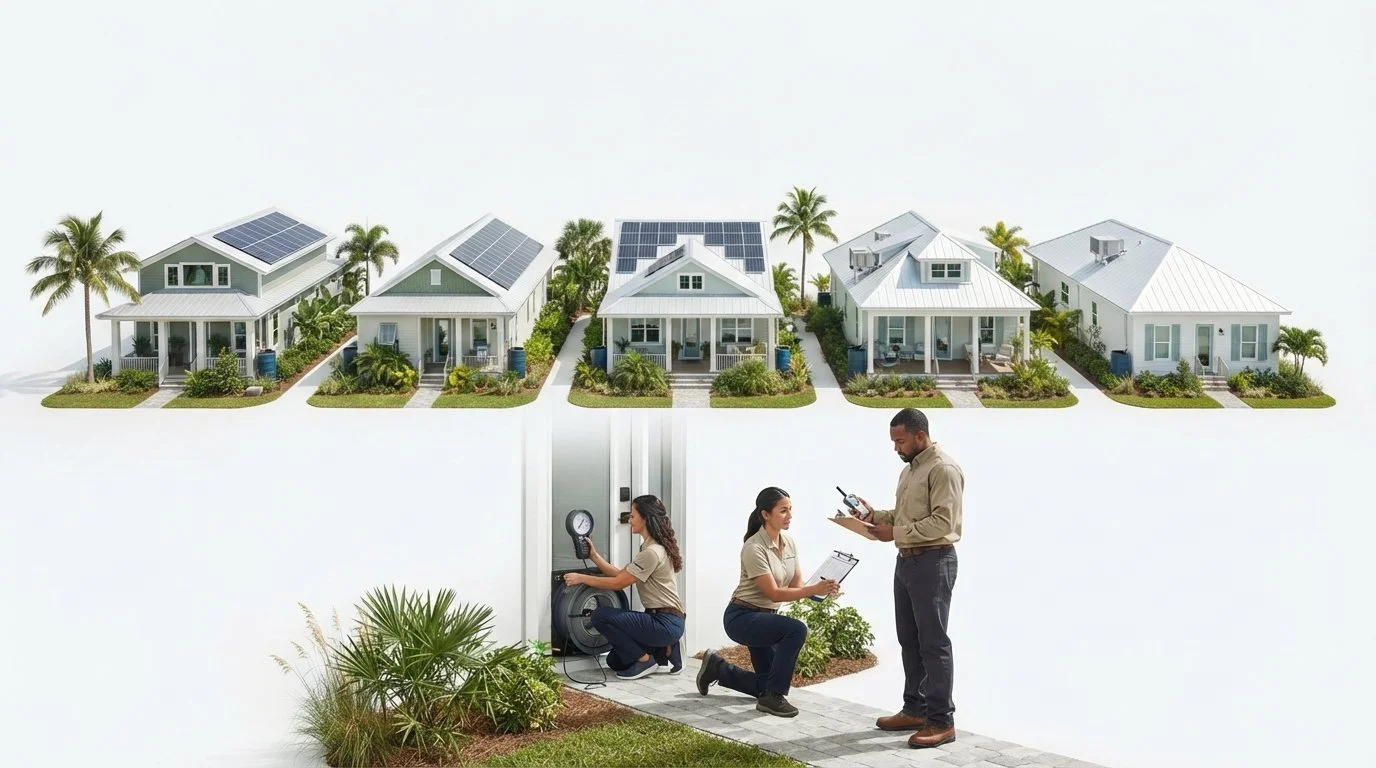
In 2026, a home that merely meets the minimum Florida Building Code is already falling behind the curve of high-performance real estate. You've likely felt the pressure of balancing the rigorous demands of LEED v5 with the practical realities of construction in the Southeast. It's a complex path, but these projects prove that environmental stewardship and market-leading performance aren't just compatible; they're essential. This year's standout projects represent the Top 5 LEED for Homes built in Florida in 2026 Homes, showcasing what's possible when technical precision meets a vision for a more sustainable future.
We understand that finding a qualified LEED Green Rater to verify these milestones is often the missing piece in your project's success. This article highlights the pinnacle of sustainable residential construction and explains how expert verification services turn ambitious green goals into certified high-performance realities. We'll preview the technical benchmarks achieved by these leaders and explore how third-party verification ensures every duct test and blower door result translates into long-term asset value. By benchmarking these top-performing projects, you can better understand how to navigate compliance and identify the right consultants to bring your own green vision to life.
Key Takeaways
Analyze the technical benchmarks like HERS scores and ERV systems that allow modern residences to outpace the 2026 Florida Building Code.
Benchmarking the Top 5 LEED for Homes built in Florida in 2026 Homes provides a clear roadmap for developers who want to achieve LEED Platinum in high-velocity hurricane zones.
Learn why a LEED Green Rater is a mandatory partner for residential certification and how they bridge the gap between design intent and verified field performance.
Discover how leveraging dual expertise in construction and real estate helps you navigate the technical complexities of LEED v5 and v4.1 requirements.
Master the verification process from the initial design charrette to final blower door testing to ensure your commitment to environmental stewardship becomes a certified reality.
Table of Contents
The State of LEED for Homes in Florida (2026)
LEED for Homes isn't just a badge; it's the global benchmark for residential sustainability. In Florida, 2026 has become a defining year as the industry moves past basic compliance toward true high-performance. As we analyze the Top 5 LEED for Homes built in Florida in 2026 Homes, we see a clear trend: developers are no longer treating green building as an optional upgrade but as a market-essential strategy. Efficiency is the new standard.
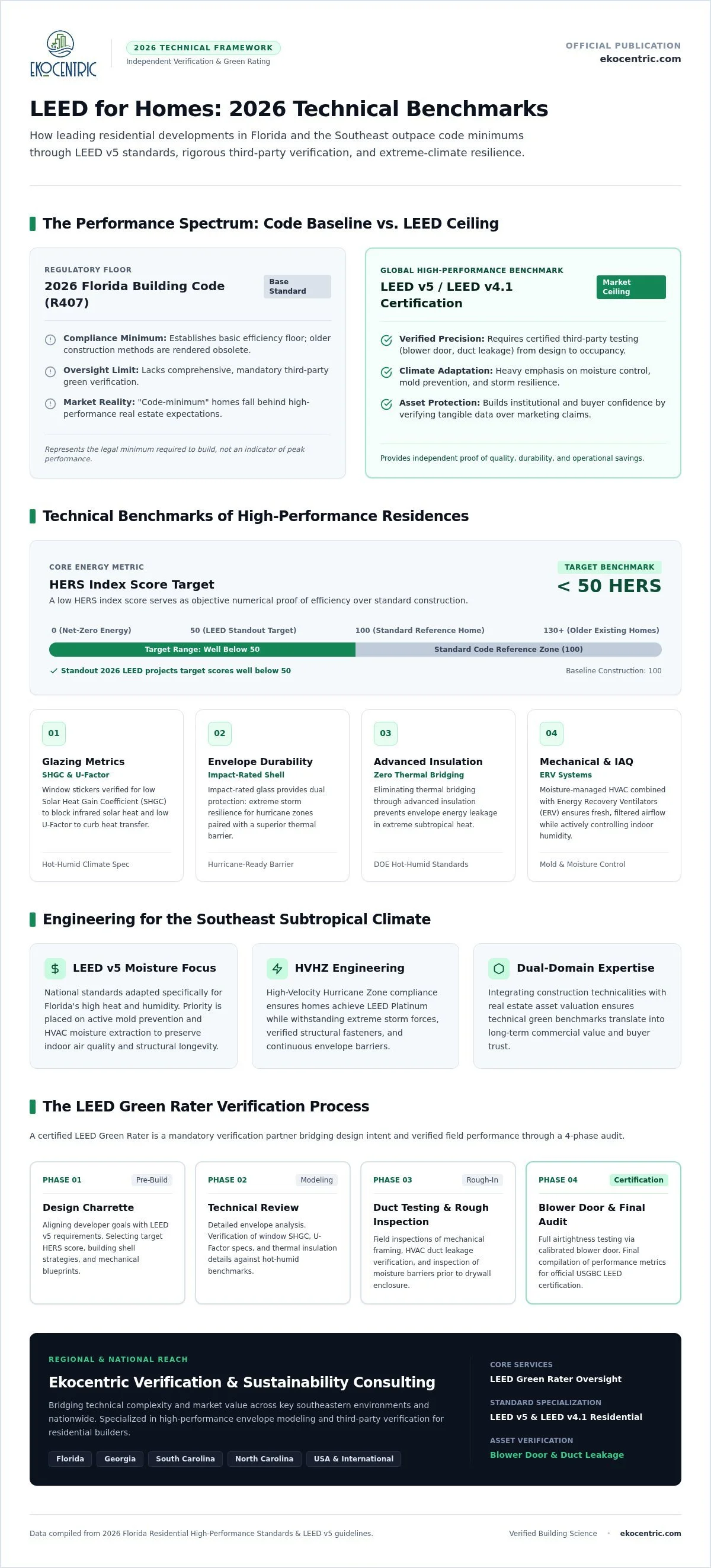
The 2026 Florida Building Code has raised the bar for energy efficiency, making older construction methods obsolete. While the code provides a floor, the LEED green building certification framework offers the ceiling that high-end buyers now expect. This shift is driven by a need for homes that can withstand extreme weather while maintaining peak efficiency. Trust requires proof.
To better understand how these standards are applied in a real-world, hurricane-resilient community, watch this overview of a premier Florida development:
LEED v5 and the Florida Climate
Adapting national standards to Florida's unique humidity and heat requires a specialized approach. LEED v5 places a heavy emphasis on moisture control and mold prevention, which are critical in our subtropical environment. These 2026 standards don't just focus on saving energy; they prioritize building resilience. High-performance homes now utilize advanced building envelopes and moisture-managed HVAC systems to ensure longevity. It's about creating a structure that remains healthy and durable even during the most intense seasonal shifts.
Beyond Code: Why Developers Choose LEED
In a competitive market, LEED certification provides a level of trust that "code-minimum" houses can't match. While the Florida Building Code's R407 requirements are strict, they don't offer the comprehensive third-party verification that LEED demands. Developers who lack internal capacity for managing these complex goals rely on certified verification services to ensure every technical milestone is met. This rigorous process builds buyer confidence by proving that a home's performance is verified by an independent expert, not just claimed by a marketing brochure. Choosing LEED is a pragmatic business decision that turns a green vision into a high-value, high-performance asset.
Technical Benchmarks of High-Performance Florida Residences
High performance is measured in data, not just intent. For the Top 5 LEED for Homes built in Florida in 2026 Homes, technical benchmarks serve as the objective proof of quality. Achieving a low HERS Index score is the primary goal; these projects often target ratings well below 50 to demonstrate significant energy savings over standard construction. This is achieved through a holistic approach that prioritizes the building envelope, mechanical efficiency, and renewable energy integration. Precision is the difference between a house that looks green and one that actually performs.
Thermal Envelope and Window Performance
Window selection is critical in the subtropics. We look specifically at the Solar Heat Gain Coefficient (SHGC) and U-Factor on window stickers to ensure they meet the rigorous demands of the Florida sun. Low SHGC values are essential to block infrared heat, while impact-rated glass provides both storm safety and a superior thermal barrier. These components work together with advanced insulation techniques to eliminate thermal bridging, which can otherwise compromise the home's efficiency. For deep technical insights into these strategies, the DOE Building America guides for hot-humid climates provide essential benchmarks for optimizing the building shell in high-moisture environments.
Mechanical Systems and Indoor Air Quality
As homes become more airtight to meet LEED standards, managing indoor air quality becomes a technical challenge. High-performance residences utilize Energy Recovery Ventilators (ERVs) to provide balanced ventilation. These systems exchange heat and moisture between incoming and outgoing air streams, which is vital for maintaining comfort in Florida’s humidity. Without proper make-up air and dedicated dehumidification, airtight homes risk mold growth. Technical precision in duct design and equipment sizing ensures that the HVAC system doesn't just cool the air but actively manages the living environment's health. It's a delicate balance of science and engineering.
To verify these systems are operating as designed, rigorous field testing is mandatory. We employ specialized blower door and duct testing to identify any leakage that could undermine performance. Finally, integrating solar arrays with safe harbor inverters allows these homes to maintain energy independence during grid outages. This combination of a tight envelope, smart ventilation, and renewable energy creates a resilient asset that far exceeds minimum building requirements. By prioritizing these benchmarks, developers create homes that are as durable as they are efficient.
Top 5 LEED for Homes Showcases in Florida (2026)
The Top 5 LEED for Homes built in Florida in 2026 Homes represent a new era of residential performance, where environmental stewardship meets uncompromising durability. These premier projects reached their certification goals through the technical oversight and expert LEED Green Rater services provided by Ekocentric. By acting as the essential technical partner, Ekocentric ensured that every design innovation translated into a verified, high-performance reality. These five showcases prove that with the right guidance, developers can outpace the 2026 building codes while creating resilient, market-leading assets.
The Coastal Net-Zero Retreat: A flagship project achieving LEED Platinum in a high-velocity hurricane zone, utilizing specialized envelope sealing.
The Urban Infill Masterpiece: This development maximizes density in metro Florida while maintaining a HERS Index score well below 50.
The Multi-Family LEED Hub: An innovative project featuring advanced energy management systems and cost-sharing infrastructure for sustainable living.
The Resilient Suburban Estate: A showcase of dual certification, integrating both NGBS Green+ and LEED for Homes standards for maximum longevity.
The Affordable Green Initiative: Proving that high-performance building is accessible through smart design and rigorous third-party verification.
Every one of these projects relied on RESNET Home Energy Rating verification to ensure performance claims were backed by objective field data. Ekocentric’s role as the RESNET HERS Rater was critical in documenting the energy savings that define these leaders.
Innovation Spotlight: Net-Zero Energy Homes
In 2026, the intersection of luxury and low-impact living is best seen in projects that achieve a HERS Index of 0 or lower. By integrating Tesla Powerwall systems with optimized solar arrays, these homes function as self-sustaining power plants. Ekocentric guided these developers through the complex LEED BD+C requirements to ensure that renewable energy inputs were perfectly balanced with a high-efficiency building shell. This technical precision provides homeowners with true energy independence and peace of mind during grid instability.
Resilience and Durability Standards
Coastal Florida demands construction that resists salt spray, extreme winds, and intense UV exposure. The business case for building above code is clear: these homes attract higher resale values and lower insurance premiums. Ekocentric leveraged its dual expertise in construction and real estate to help these developers select materials and systems that exceed basic durability requirements. By focusing on building performance optimization rather than just the certification plaque, these projects set a new benchmark for what sustainable Florida real estate should be.
Navigating the Certification Path: The Role of a Green Rater
While architects create the vision and contractors execute the build, the LEED Green Rater serves as the essential third-party verifier who guarantees performance. For the Top 5 LEED for Homes built in Florida in 2026 Homes, this role was mandatory to bridge the gap between technical blueprints and real-world results. A rater doesn't just check boxes; they provide the rigorous field verification required by the USGBC to ensure a home is truly high-performance. Without this oversight, residential projects cannot achieve certification, leaving developers without the verified credentials they need for market differentiation.
There's a deep synergy between LEED Green Rating and RESNET HERS Indexing. The HERS Index provides the energy-specific data that forms the backbone of the LEED energy and atmosphere category. By integrating these systems, we provide developers with a comprehensive view of a home's efficiency and environmental impact. This dual-layered verification builds immense trust with buyers who want proof that their investment is durable and efficient. It's a pragmatic way to turn environmental stewardship into a tangible asset.
The Value of the Design Charrette
Cost-effective green building starts long before the foundation is poured. A design charrette is a collaborative session where we set clear performance goals and identify potential hurdles early. This proactive approach saves developers significant costs by avoiding mid-construction changes that often plague unguided projects. Setting these benchmarks during the planning phase ensures the entire team is aligned on the path to LEED Platinum. Learn more about our LEED Green Rater services to understand how we support your project from the very first sketch.
On-Site Verification and Testing
Field inspections are the heart of the verification process. During a LEED for Homes inspection, we conduct multiple site visits to verify insulation installation, framing, and mechanical systems. The most critical moments involve blower door testing and duct testing. These tests identify hidden leaks that could compromise indoor air quality or drive up energy costs. We meticulously document every finding to demonstrate compliance for the USGBC and the Florida Green Building Coalition.
Common pitfalls in Florida LEED projects often stem from poor moisture management or inadequate communication between trades. We act as your technical partner to navigate these complexities, ensuring that your building envelope remains airtight and your mechanical systems are sized correctly for our hot-humid climate. If you're ready to ensure your next build meets these elite standards, contact our team for expert LEED consulting and verification.
Optimizing Building Performance with Ekocentric
Achieving the standards seen in the Top 5 LEED for Homes built in Florida in 2026 Homes requires more than just a commitment to sustainability; it requires a technical partner who understands the intersection of construction and certification. At Ekocentric, we provide the specialized expertise that developers and architects need to turn complex green goals into verified realities. Our dual expertise as licensed Florida Certified Building Contractors and real estate professionals gives us a unique perspective on both building performance and market value. We don't just consult; we verify.
Many project leads find themselves lacking the internal capacity to manage the overlapping requirements of LEED, NGBS, FGBC, and ENERGY STAR. We fill that gap. By acting as your LEED Green Rater and RESNET HERS Rater, we streamline the process across the Southeast, including Florida, Georgia, South Carolina, and North Carolina. Our mission is to ensure that your dedication to environmental stewardship translates into a high-performance asset that stands the test of time.
A Pragmatic Partner for Sustainable Development
We focus on building performance optimization rather than just chasing a plaque. Our team understands that every blower door test and duct leakage report is a data point for long-term durability. We partner with you to solve operational pain points, ensuring your project meets the 2026 Florida Building Code while reaching for the highest tiers of the Top 5 LEED for Homes built in Florida in 2026 Homes. This pragmatic approach minimizes risk and maximizes the quality of the living space. We see the results of our work in the comfort of the residents and the efficiency of the structures.
Get Started on Your 2026 LEED Project
Standardizing your green building process across multiple states requires consistency and technical depth. Whether you're building in metro Florida or expanding into the Carolinas, we provide the technical performance consultations necessary to succeed. We help you navigate the nuances of LEED BD+C and ensure your team is prepared for every field inspection. High-performance building is an achievable solution to global environmental challenges, and we're here to lead the way. We invite you to partner with Ekocentric for your next high-performance build. Let's work together to create homes that lead the industry in efficiency, resilience, and long-term value.
Building the Future of Florida Real Estate
High-performance residential construction has evolved from a niche preference into a market-essential standard. The Top 5 LEED for Homes built in Florida in 2026 Homes prove that technical precision and environmental stewardship create resilient, high-value assets. Achieving these results requires more than just high-quality materials; it demands the rigorous oversight of a dedicated technical partner. Third-party verification remains the only way to ensure that your design intent translates into verified field performance.
At Ekocentric, we bridge the gap between complex certification requirements and successful project completion. As a Licensed Florida Certified Building Contractor and expert LEED Green Rater, we bring dual expertise to every build. We help developers across Florida, North Carolina, and South Carolina navigate the nuances of LEED and HERS ratings with pragmatic, results-oriented solutions. It's time to turn your green vision into a certified reality that stands the test of time. Schedule your LEED project consultation with Ekocentric today to secure your project's performance. Together, we can build a more sustainable and resilient future for our communities.
Frequently Asked Questions
What is the difference between LEED for Homes and FGBC certification?
LEED is a globally recognized standard managed by the USGBC, while FGBC certification is specific to the unique environmental challenges of Florida. Both frameworks promote sustainable building, but LEED often carries more prestige for international investors. We provide consulting for both standards to help developers choose the path that best fits their project goals. This decision often depends on whether you prioritize localized climate optimization or broad market recognition for high-performance residences.
How much does a LEED Green Rater cost for a Florida residential project?
The investment for LEED Green Rater services depends on the project's size, complexity, and specific certification goals. We don't provide fixed industry prices because every build requires a custom verification plan. Factors that influence the final cost include the number of site visits, the depth of the design charrette, and the performance testing needed to verify the Top 5 LEED for Homes built in Florida in 2026 Homes. Every project is unique.
Is a HERS rating the same as a LEED verification?
A HERS rating measures energy efficiency specifically, while LEED verification is a holistic assessment of a home's total environmental impact. The HERS Index score is a mandatory component of the LEED energy category, but LEED also evaluates water use, indoor air quality, and sustainable materials. We serve as both HERS Raters and Green Raters to provide a seamless certification path that covers every technical benchmark required for high-performance residential living.
What are the new requirements for the 2026 Florida Building Code?
The 2026 Florida Building Code introduces more stringent energy efficiency standards and enhanced resilience requirements for high-velocity hurricane zones. These updates align more closely with national high-performance standards, making third-party verification essential for compliance. We help developers navigate these regulations by performing mandatory blower door and duct testing. This ensures that every residence meets the new performance thresholds while maintaining the structural integrity required for our subtropical climate.
Can a multi-family project in Florida achieve LEED Platinum status?
Multi-family projects can definitely achieve LEED Platinum status through strategic planning and technical precision. These developments often use shared energy systems and advanced building envelopes to maximize efficiency across all units. Achieving this top tier requires a dedicated Green Rater to oversee the verification process from the design stage through final occupancy. This rigorous oversight ensures that every unit performs as intended and meets the strict standards required for the highest certification level.
Why is mold prevention so critical in Florida LEED homes?
Mold prevention is vital in Florida because airtight, high-performance homes can trap moisture if they aren't managed correctly. LEED standards prioritize moisture control through advanced building envelopes and dedicated dehumidification systems. We verify that projects include proper drainage planes and HVAC sizing to prevent the condensation that leads to mold growth. This protects the health of the occupants and ensures the long-term durability of the structure in our hot-humid environment.
What is an ERV and why do LEED homes in Florida require one?
An Energy Recovery Ventilator (ERV) is a mechanical system that provides balanced ventilation while exchanging heat and moisture between incoming and outgoing air. In Florida, ERVs are essential for LEED homes because they allow for fresh air intake without overloading the HVAC system with excess humidity. This technology ensures superior indoor air quality in the Top 5 LEED for Homes built in Florida in 2026 Homes while maintaining peak energy efficiency.
How does the NGBS Green+ badge differ from standard NGBS certification?
NGBS Green+ badges are supplemental certifications that highlight specific performance achievements beyond the standard Bronze, Silver, Gold, or Emerald levels. These badges focus on specialized areas such as resilience, smart home technology, or universal design. As National Green Building Standard Green NGBS Verifiers, we help clients identify which badges best suit their project's mission. This allows developers to further differentiate their sustainable properties and showcase their commitment to specific high-performance goals.